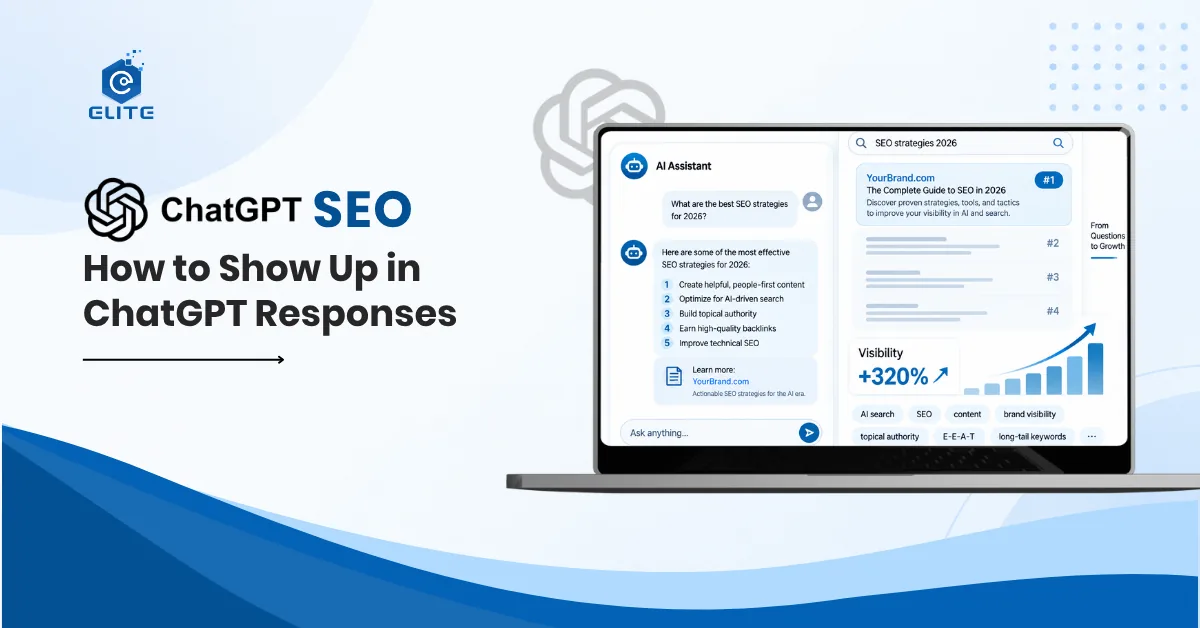
Search has fundamentally changed right under our feet. A few years back, we all focused entirely on getting our websites onto the blue links of Google's first page. If you held position one or two for a high-intent term, your business was sorted. Today, things look very different. Millions of customers daily do not open a standard search tab anymore. They open a prompt box and ask AI conversational tools directly for advice. They type things like, *who is the best corporate IT consultant near Oxford Street?* or *find me a reliable tax advisor in Manchester with transparent pricing.*
When someone asks ChatGPT a question like that, the AI does not return ten links for the user to click through. It gives a direct, structured answer. It names specific brands, explains why those brands fit the brief, and links directly to their web properties. If your company is not featured inside that answer, you do not exist to that user. At Elite Information Tech, we call this shift Generative Engine Optimization. It is the art and science of ensuring your digital presence is readable, authoritative, and irresistible to Large Language Models.
In this comprehensive guide, we are going to break down exactly how conversational AI platforms evaluate web content, how they extract entity facts, and how you can optimize your digital assets to dominate ChatGPT answers alongside traditional organic rankings.
Why Should You Do SEO for ChatGPT?
You might wonder why your business needs to worry about generative AI if your organic Google traffic feels relatively stable. The reality is that search habits are fragmenting rapidly. Early adopters, business owners, and high-value buyers are increasingly turning to AI tools to filter out search clutter.
Increased Visibility
When a prospective client uses an AI engine to solve a problem, they are skipping the top ad slots and sponsored listings. They want an objective recommendation. Appearing inside a conversational response provides an extraordinary boost in credibility. It acts less like a cold advertisement and more like a warm digital referral.
· Instant Trust: Being cited by an AI engine signals to the user that your brand is an established authority in your space.
· High-Intent Referral Traffic: Users who click on citations embedded within AI answers have already read a summary of your services. They arrive on your site ready to convert.
· Cross-Platform Presence: AI models pull data from across the web. Dominating ChatGPT answers usually means you are simultaneously appearing in Microsoft Copilot, Perplexity, and Google AI Overviews.
Meet More Specific Intents
Traditional search keywords tend to be short and rigid, like *SEO agency London*. But prompt search behavior is conversational, long-tail, and highly nuanced. People ask full, complex questions: *We are a 20-person legal firm near Commercial Road needing an SEO partner that specializes in local entity architecture. Who should we hire?*
Standard organic landing pages often fail to answer these ultra-specific queries because they were designed for broad keywords. By optimizing your digital ecosystem for generative AI, you position your brand to capture these highly specific, ready-to-buy prospective clients.
Strategic Comparison: Traditional Search vs Generative Engine Optimization
|
Optimization Focus |
Traditional Search Engine Optimization |
ChatGPT & Generative Engine Optimization |
|
Primary Output |
List of ranked URL hyperlinks (Blue Links) |
Direct synthesized text answers with embedded citations |
|
Query Structure |
Short keyword strings (e.g., 'commercial electrician Birmingham') |
Conversational, multi-layered prompts with context and constraints |
|
Search Engine Indexing |
Googlebot / Bingbot crawling HTML page elements |
Bing Indexing + Real-time web search integration + LLM training data |
|
Content Value Metric |
Keyword density, backlinks, exact match titles |
Clear factual structures, entity clarity, schema, third-party sentiment |
|
User Conversion Journey |
User clicks link -> landing page -> form submit |
User reads AI recommendation -> clicks verified citation -> immediate call |
How to Do SEO for ChatGPT in 3 Steps
Winning visibility inside conversational AI requires a methodical strategy. It is not about tricking an algorithm. It is about making your brand's data so clear, consistent, and verifiable that the AI model feels totally confident recommending you to its users. Here is our proven three-step execution framework.
Step 1. Ensure Your Site Is Indexed by Search Engines
ChatGPT does not rely solely on static training memory. When users ask questions requiring fresh, local, or commercial information, ChatGPT browses the web in real-time. Crucially, ChatGPT relies heavily on underlying search engine indexes to locate live web pages. If your site is hidden from search bots, AI systems will completely bypass your business.
Make Sure You're in Bing's Index
This is a point many digital marketers miss. While Google controls the majority of traditional search traffic, ChatGPT has a deep partnership with Microsoft. OpenAI uses Bing as a foundational search backbone to execute live web queries.
· Verify Bing Webmaster Tools: Ensure your site is registered with Bing Webmaster Tools and your XML sitemaps are submitted without errors.
· Check Crawler Accessibility: Verify that your `robots.txt` file permits `Bingbot` and `MSNBot` to crawl your critical landing pages and service directories.
· Inspect Indexation Status: Perform a direct `site:yourdomain.co.uk` query on Bing to confirm your key location and service pages are active in the index.
Make Sure You're in Google's Index
Simultaneously, you must maintain absolute indexation strength on Google. Google AI Overviews and standard organic rankings rely directly on Google Search Console data. Ensuring your technical foundation is spotless across both index ecosystems guarantees maximum coverage.
· Eliminate Crawl Blocks: Ensure `OAI-SearchBot` and standard search crawlers are not blocked by firewall rules or misconfigured server directives.
· Optimize Render Speed: Fast-loading, lightweight HTML pages allow search crawlers to extract content quickly without timing out.
Step 2. Write Content That's Primed for AI Extraction
Generative AI models do not read websites the way humans do, nor do they scan for keywords like basic search algorithms. They process content as semantic nodes and relationships. To get cited in AI responses, your content must be structured for smooth semantic parsing.
Use a Clear Content Structure
Ambiguous writing confuses language models. If your landing pages use overly clever sales copy or obscure headlines, an AI model will struggle to determine what you actually do. Structure your pages logically so that both human readers and AI models can quickly scan your offering.
· Inverted Pyramid Format: Place direct answers, core definitions, and service summaries right at the top of your pages before diving into background context.
· Semantic Header Tagging: Use logical `<H2>`, `<H3>`, and `<H4>` hierarchies that explicitly declare topic subjects.
· Structured Data Schemas: Implement robust `Organization`, `LocalBusiness`, and `Service` schema markup. Explicitly declare your business address, phone number, operational hours, and service boundaries in clear JSON-LD format.
Use a Direct and Specific Writing Style
AI models favor content that answers questions straightforwardly. When crafting content for Elite Information Tech clients, we emphasize factual clarity over fluff.
· Answer Questions Immediately: Follow every heading with a clear, definitive 1-2 sentence statement before elaborating.
· Use Real Geographic Identifiers: Name actual streets, landmarks, and operational districts. Mentioning areas like *Regent Street*, *Paddington*, or *Deansgate* gives search engines immediate geographic context.
· Incorporate Data & Evidence: Back up assertions with concrete metrics, verified client outcomes, and clear pricing or service parameters.
Step 3. Build Brand Mentions and Authority Signals
ChatGPT does not base its recommendations solely on what you say about yourself on your own website. Large Language Models scan the wider web to evaluate your brand's overall reputation. They look at what third parties, news outlets, industry directories, and customer reviews say about you.
Continue Building Backlinks
Traditional backlinks remain a fundamental signal of web authority. High-quality links from trusted industry publications tell search engines that your website is a reliable source of information.
· Industry-Specific Link Building: Focus on securing editorial mentions on respected trade websites and regional news portals.
· Local Business Listings: Ensure your business is listed accurately on primary UK directories with identical Name, Address, and Phone (NAP) details.
Get Brand Mentions in Relevant Publications
Unlinked brand mentions are exceptionally powerful in the world of Generative Engine Optimization. Large Language Models process mentions of your company name across Reddit, local news forums, review portals, and industry blogs as entity validation.
· Active Review Management: Consistently collect genuine customer reviews on Google Business Profile, Trustpilot, and specialist platforms. Ensure reviews naturally mention your services and specific locations.
· Digital PR Campaigns: Publish expert commentary on regional business developments or industry trends to earn natural media citations.
· Entity Alignment: Keep your brand description completely consistent across every external platform, social media profile, and directory listing.
How to Measure Your ChatGPT SEO Performance
Measuring AI search performance requires a modern approach to tracking. Traditional rank tracking tools that only check Google position numbers will miss the full picture of your AI visibility.
· Prompt Testing & Sampling: Regularly run a standardized set of high-intent prompts in ChatGPT, Bing Chat, and Perplexity. Track whether your brand appears in the response body or as a source citation.
· Referral Traffic Analytics: Monitor your web analytics for referral traffic originating from domain sources like `chatgpt.com`, `bing.com`, or `perplexity.ai`.
· Brand Search Impression Spikes: Watch for increases in direct branded search queries on Google and Bing. Customers who read about your business in an AI summary often perform a follow-up direct brand search.
· Lead Source Attribution: Add a simple question to your website intake forms asking clients: *Did you find us via Google, an AI recommendation tool, or a referral?*
Boost Your Brand's Visibility with SEO for ChatGPT
The transition toward conversational, AI-driven search is not a distant future trend; it is happening right now. Businesses that optimize their digital presence for generative engines today will build an unassailable advantage over competitors who rely solely on legacy search techniques.
At Elite Information Tech, we specialize in cutting-edge SEO strategies that connect your brand directly with high-intent buyers, whether they are searching on traditional Google maps or querying ChatGPT on their mobile devices.
Are you ready to ensure your business dominates conversational AI answers and drives qualified customer leads? Contact Elite Information Tech today to book your comprehensive Generative Engine Optimization audit and take total control of your digital footprint.