
Key takeaways
- AI answers now reach billions of people. Being cited and mentioned across the web matters as much as being linked.
- Google confirmed four spam updates and two core updates in 2026. Links it neutralises don’t trigger a warning. They just stop working.
- The best link building services for agencies sell editorial placements, brand mentions and digital PR, not bulk “DR 50+” packages.
- Vet every backlink provider on real traffic, traffic geography, topical fit and editorial standards, not authority scores alone.
Most agency owners we speak with don’t have a link building problem. They have a capacity problem that looks like a link building problem.
You sign a new SEO retainer, the audit is clean, content is shipping. Then around month three the client asks why their money keywords haven’t moved. You know the answer: the site needs authority, authority means links, and links mean outreach. Hundreds of emails, dozens of follow-ups, a high rejection rate. BuzzStream’s research found 60% of link builders get only three to six months to prove their work is paying off, which is not much time to build a team from scratch.
So most growing agencies ask the same question: who can we trust to do this for us, under our brand, without putting our clients at risk? This guide answers it for agencies in the US, UK, Canada and Australia weighing white label link building services, using published research rather than opinion wherever we can.
Short answer: White label link building services let an SEO or digital marketing agency outsource backlink acquisition to a specialist partner, who finds, secures and reports links under the agency’s own brand. Heading into 2027, the best services focus on relevant editorial placements and brand mentions on sites with real traffic, because these support both Google rankings and visibility in AI answers such as Google AI Overviews and ChatGPT.
Why is link building harder (and more valuable) heading into 2027?
Link building is harder going into 2027 because AI answers absorb clicks and Google keeps discounting manipulative links, so only relevant, editorially earned links still move rankings.
Clicks are shrinking, and AI answers are huge
The scale of AI search is no longer a forecast. Google said in July 2025 that AI Overviews had more than 2 billion monthly users and AI Mode had 100 million in the US and India. In February 2026, OpenAI reported 900 million weekly ChatGPT users.
The cost to publishers shows up in every major study:
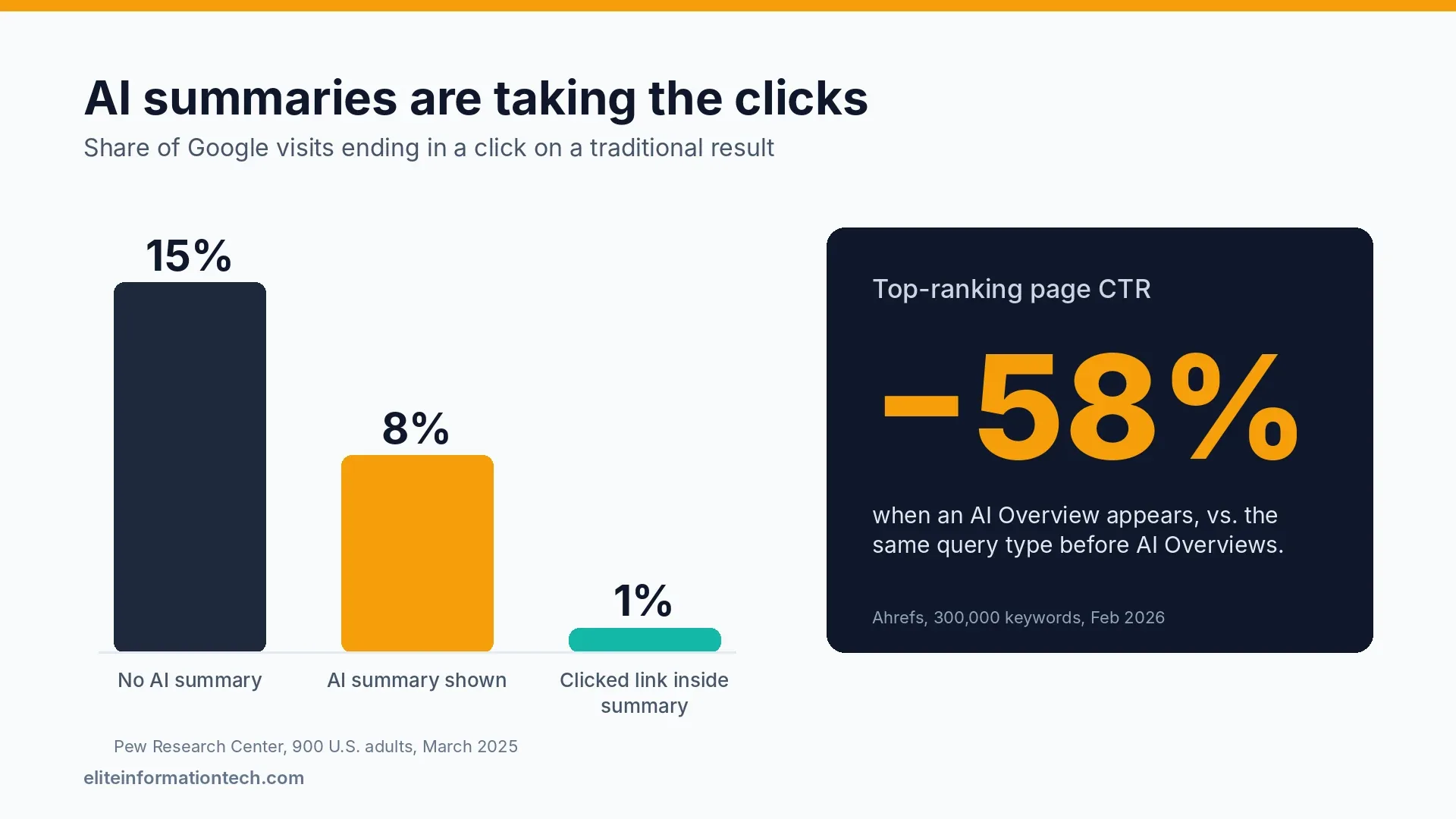
- Ahrefs (Feb 2026), 300,000 keywords: the top-ranking page sees a 58% lower average click-through rate when an AI Overview appears.
- Pew Research Center (2025), 68,879 real searches by 900 US adults: people clicked a traditional result on 8% of visits with an AI summary, against 15% without one. Only 1% clicked a link inside the summary.
- SparkToro and Datos (2024): 58.5% of US Google searches ended without a click. For every 1,000 searches, only 360 clicks reached the open web.
That sounds like bad news for SEO. It’s really a change in what “winning” looks like.
Seer Interactive tracked 25.1 million organic impressions across 42 organisations from June 2024 to September 2025. When a brand was cited inside the AI Overview, it earned 35% more organic clicks and 91% more paid clicks than when it wasn’t. Seer notes this is correlation; strong brands may simply be cited more often.
Ranking in the top 10 no longer guarantees a citation
In July 2025, Ahrefs found 76% of AI Overview citations came from pages ranking in the top 10. Its updated analysis of 863,000 keywords and 4 million AI Overview URLs, reported in March 2026, put that figure at just 38%. Ahrefs says its parsing method changed, so the numbers aren’t directly comparable. But the direction is clear: AI systems are pulling from a wider pool of trusted sources than the classic top 10.
For agencies, that means links can’t just push one page up one ranking. They need to build the client’s presence across the sites AI systems trust.
What gets a brand mentioned in AI answers?
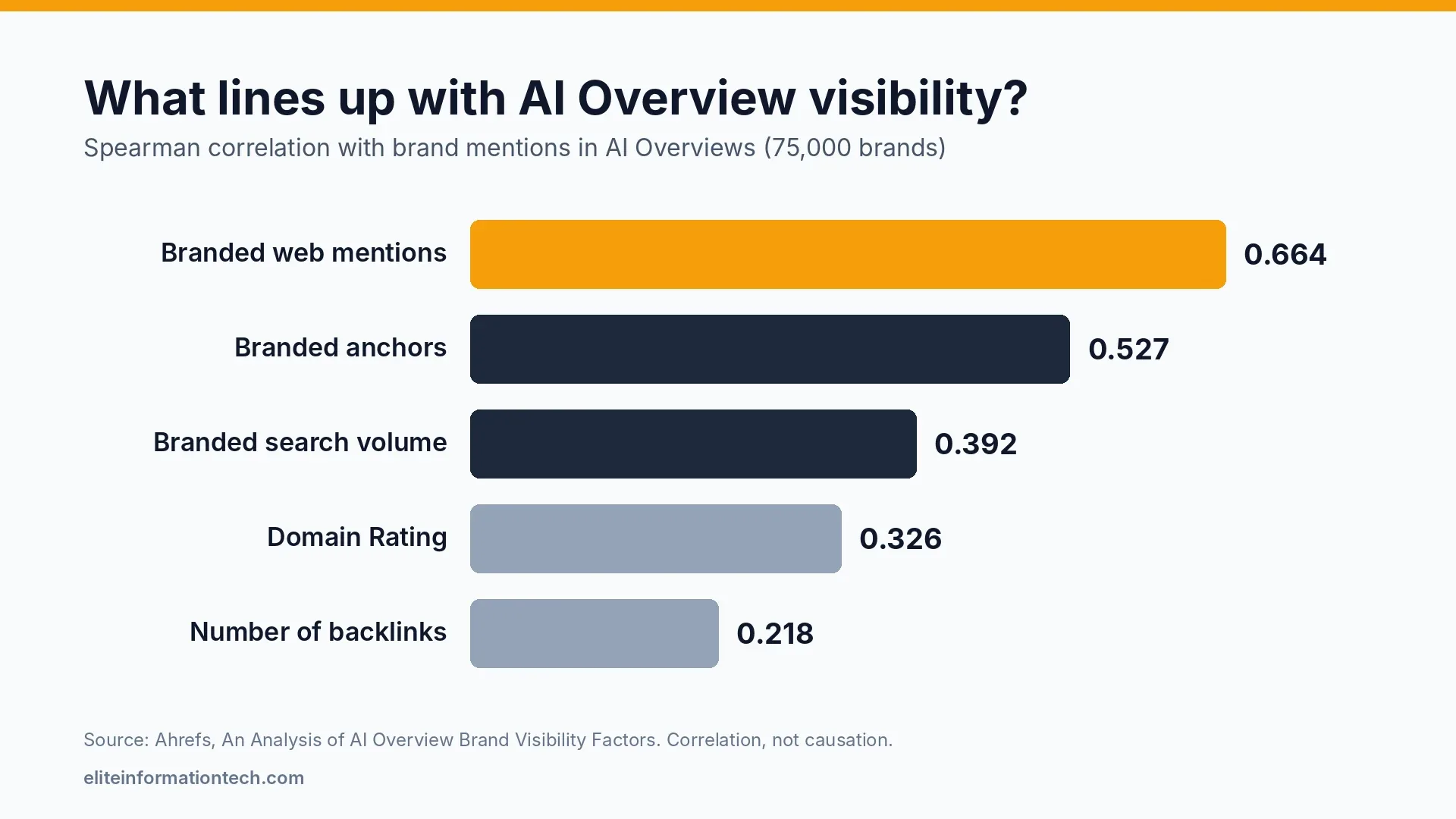
Ahrefs studied 75,000 brands to see which factors line up most closely with appearing in AI Overviews:
| Factor | Correlation with AI Overview visibility |
|---|---|
| Branded web mentions | 0.664 |
| Branded anchors | 0.527 |
| Branded search volume | 0.392 |
| Domain Rating | 0.326 |
| Number of backlinks | 0.218 |
These are correlations, not proof of cause, as Ahrefs points out. But raw link count was the weakest signal, and being talked about on relevant sites, by name, was the strongest. Links still matter for classic rankings, too: Backlinko’s analysis of 11.8 million results found the #1 result had 3.8 times more backlinks than positions two to ten.
So a supplier selling “30 links per month, DR 40+, any niche” is selling a product built for 2019.
Google keeps cleaning house
Google’s Search Status Dashboard lists eight ranking updates between August 2025 and September 2026, including four spam updates in 2026 alone. Link spam is handled by a separate system, and Google has been explicit about how it works. When it launched its December 2022 link spam update, Google said SpamBrain “can now detect both sites buying links, and sites used for the purpose of passing outgoing links”, and that “any credit passed by these unnatural links” is lost.
There’s rarely a warning. The link stops passing value. The report still says “40 links built”, but rankings don’t move. That’s the real risk in outsourcing link acquisition: not a dramatic penalty, but quietly paying for nothing until the client leaves.
What are white label link building services?
White label link building means a specialist supplier does the prospecting, content and outreach, and delivers the finished work under your agency’s brand. Your client never sees the supplier, and you set the retail price.
| Service | What you’re buying | Best for |
|---|---|---|
| White label link building services | End-to-end campaigns under your brand | Agencies selling SEO retainers |
| White label backlink services | Individual placements per client or URL | SEO resellers and smaller agencies |
| Guest posting services for agencies | Articles placed on relevant third-party blogs | Agencies buying placements by niche |
| Blogger outreach services for agencies | Relationship-led outreach to bloggers and editors | Agencies outsourcing manual outreach |
| Link building outsourcing services | Your strategy, their execution team | Agencies with an SEO lead but no outreach capacity |
| Digital PR | Data and expert commentary that earn coverage | Competitive niches and brand building |
A good link building partner for agencies blends these to suit each client.
Which types of backlinks are worth paying for in 2027?
1. Editorial guest contributions on real publications
Guest posting works when it’s publishing, not a link transaction: genuine organic traffic, a real editor, and an article worth reading without the link. The best white label guest posting services pitch topics to editors first.
Be clear about the rules. Google’s spam policies list “exchanging money for links, or posts that contain links” and “links with optimized anchor text in articles, guest posts, or press releases distributed on other sites” as link spam. Paid placements should carry rel="sponsored" or rel="nofollow". A trustworthy guest post provider for SEO agencies will tell you which placements are editorial and which involve a publisher fee.
2. Resource and contextual inclusions
Getting a client added to an existing, relevant article works because the page already has authority and traffic. BuzzStream puts the average link insertion at around $179.
3. Digital PR and data-led stories
Original data and expert commentary earn coverage that cold outreach can’t reach. It costs more (BuzzStream’s research puts the average digital PR link at about $750) but it creates exactly the branded mentions AI systems pick up. In BuzzStream’s State of Digital PR 2026 survey, 51.4% of practitioners saw measurable results within three to six months.
4. Unlinked brand mention reclamation
Established clients are often mentioned online without a link. Asking for attribution is one of the highest-return tasks in SEO, and one many suppliers skip.
5. Partner, supplier and association links
Manufacturers, distributors, trade bodies and event sponsorships. Hard to fake, highly trusted, and often ignored because someone has to actually talk to the client.
private blog networks, “DR 70 for $40” listings, sitewide footer links, and sites that publish anything from crypto to dog food. Be wary of “high authority” placements on big-brand subfolders too. Google’s site reputation abuse policy targets third-party content published “mainly because of that host’s already-established ranking signals”. In September 2024, analyst Glenn Gabe reported around 1.7 million Forbes Advisor queries dropped or vanished. If that can happen to Forbes, it can happen to the pages your links sit on.
How do you vet a backlink provider for SEO agencies?
DR, DA and AS are useful filters, but they’re third-party estimates, not Google signals. Here’s the nine-point check we run on every prospect site before a link is placed.
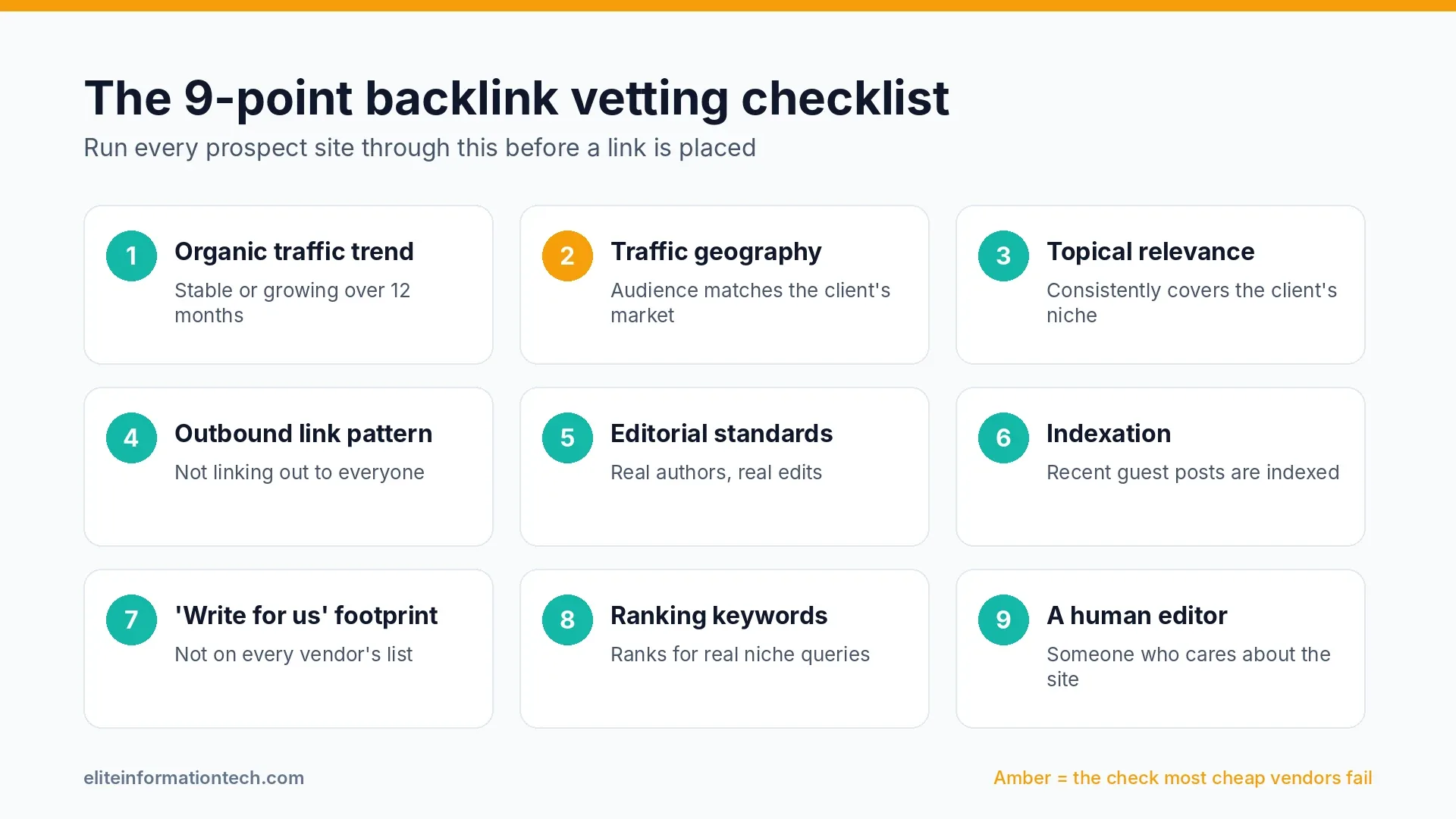
- Organic traffic trend. Stable or growing over 12 months?
- Traffic geography. Does the audience match the client’s country? Most cheap vendors fail this check.
- Topical relevance. Does it consistently cover the client’s industry?
- Outbound link pattern. A site that links out to everyone passes little to anyone.
- Editorial standards. Real author bylines and real edits.
- Indexation. Are recent guest posts actually indexed? If not, Google may already be ignoring them.
- “Write for us” footprint. Sites that advertise it aggressively are on every vendor’s list.
- Ranking keywords. Does it rank for real niche queries, or only its own brand?
- A human editor. Someone who cares about the site.
Ask any supplier for ten recent live placements in your niche and run them through this list.
How does a white label link building workflow run?
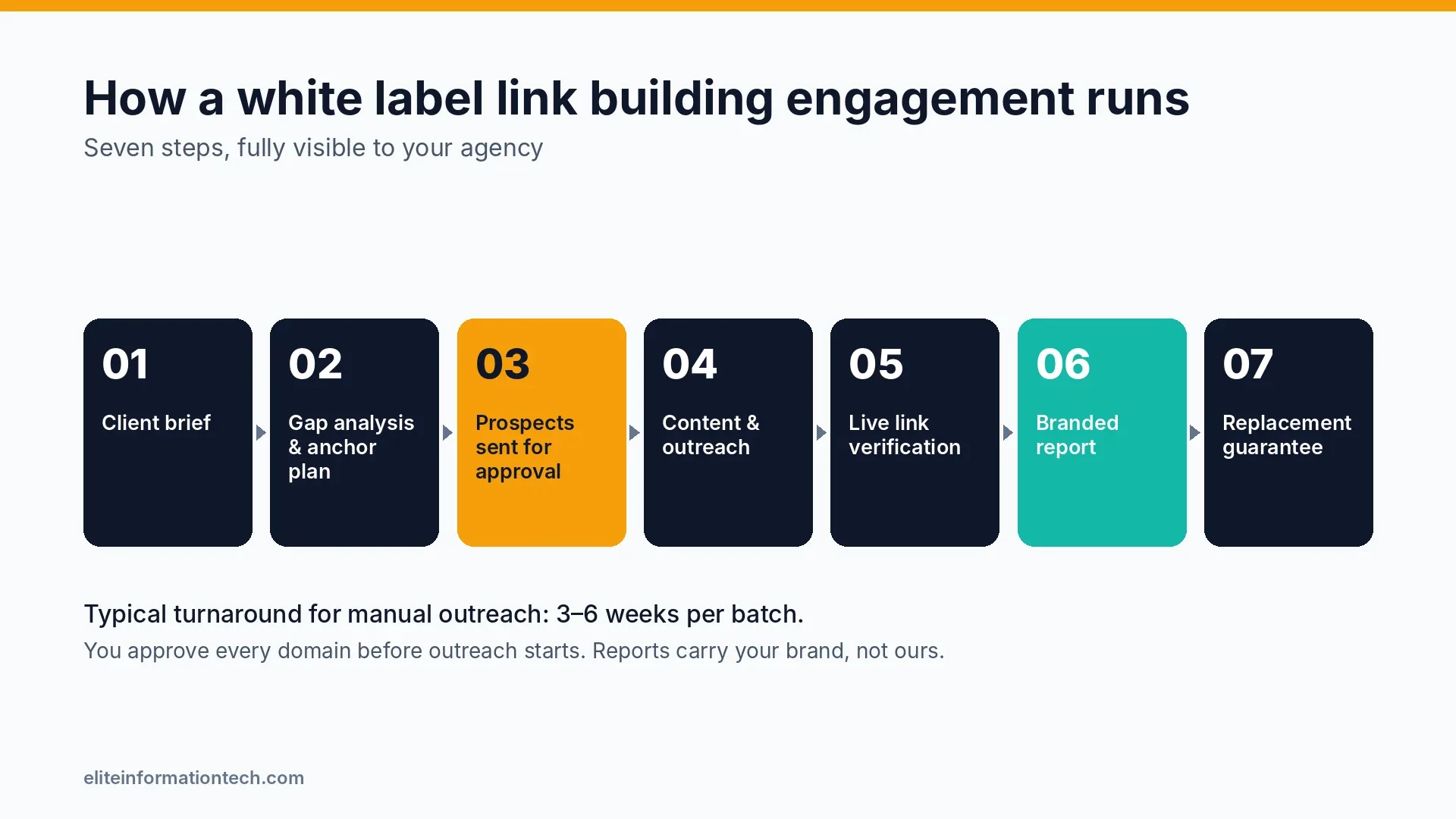
- Client brief. Target pages, keywords, markets (US, UK, CA, AU) and anything off-limits.
- Backlink gap and anchor plan. Competitor gap analysis and a natural anchor mix, mostly branded and URL anchors.
- Prospect list for approval. You see every site before outreach begins.
- Content and outreach. Topic pitches, editor conversations, writing, revisions.
- Live link verification. Indexation, attributes and target URL checked.
- White-labelled reporting. Live URLs, metrics and screenshots under your brand.
- Replacement guarantee. Removed links replaced within an agreed window, commonly six to twelve months.
Manual outreach takes three to six weeks per batch. Twenty-five relevant placements in seven days means a pre-built inventory.
How much does white label link building cost? (Wholesale pricing explained)
You’re paying for three things: outreach time, content quality, and the site itself. Here’s what published research shows:
| Placement type | Typical cost | Source |
|---|---|---|
| Link insertion | ~$179 average | BuzzStream |
| Guest post bought directly | ~$295 average | BuzzStream |
| Guest post through a vendor | ~$461 average | BuzzStream |
| Digital PR link | ~$750 average | BuzzStream, State of Digital PR |
| Top-tier guest post | $3,130–$6,018 | BuzzStream |
Pricing models are usually per link, monthly retainer, or link building wholesale pricing: discounted per-link rates for committed volume. Expect costs to keep rising; in Editorial.link’s State of Link Building survey, almost 81% of link builders expected prices to increase over the next two to three years. If a quote is far below these ranges, ask how. Most answers involve link farms.
The margin maths
Here’s an illustrative example. Your client pays $3,000 per month. You buy eight placements at a wholesale rate of $220 each, so $1,760 in fulfilment. That leaves $1,240 for strategy, account management and margin, with no outreach salaries or tool subscriptions.
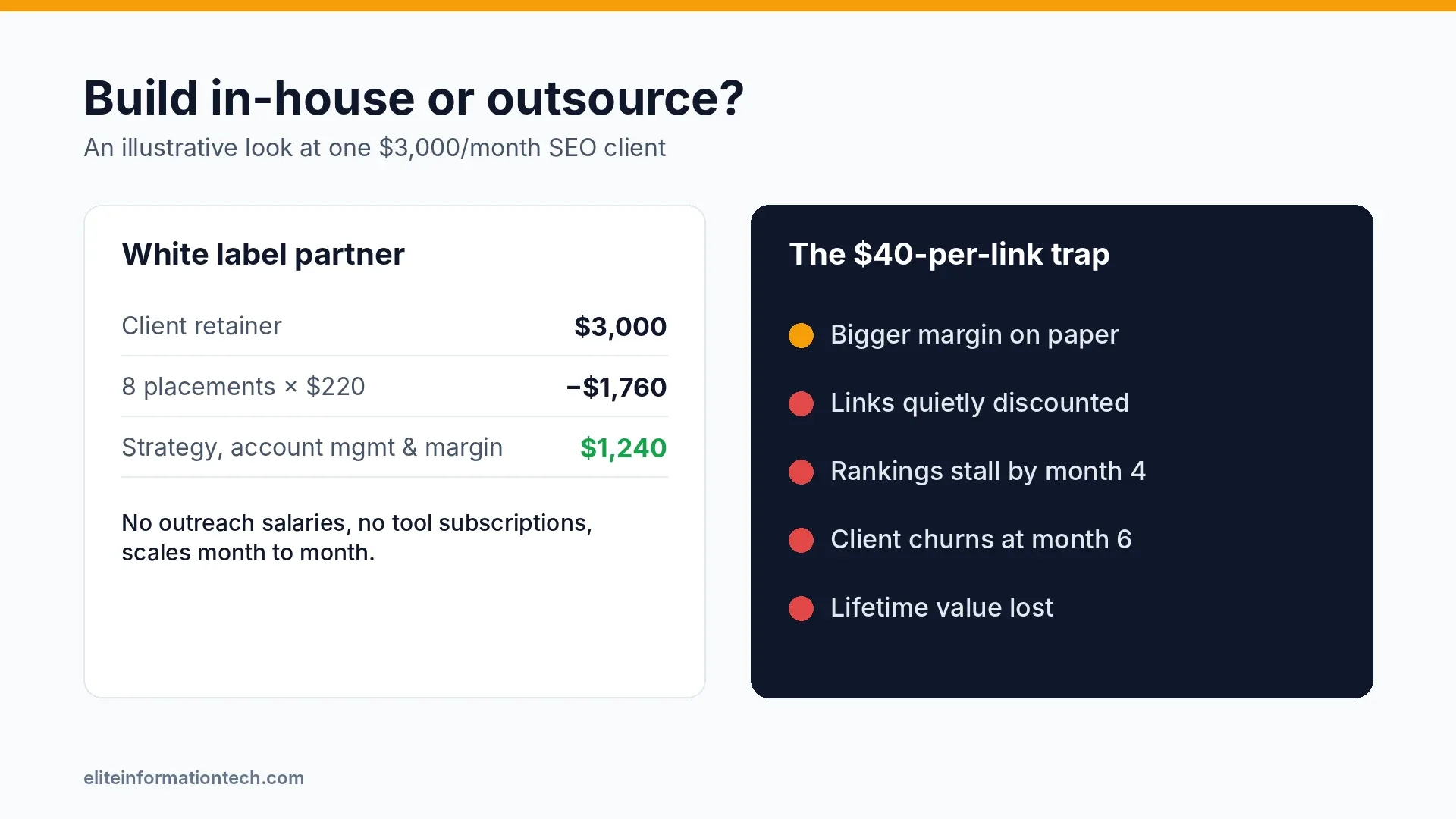
Run the same maths with a $40-per-link vendor and your margin looks far bigger. But if those links get discounted and the client churns at month six, you’ve lost the lifetime value of the account.
Should agencies build a link team in-house or outsource?
| Factor | In-house link team | White label partner |
|---|---|---|
| Upfront cost | Salaries, tools, training | Pay per placement or retainer |
| Time to first results | Two to three months to hire and ramp up | First links usually within four to six weeks |
| Scalability | Limited by headcount | Scales month to month |
| Publisher relationships | Built from scratch | Existing editor network |
| Best for | Large agencies with steady volume | Most agencies, freelancers and resellers |
What should agencies plan for in 2027?
Based on the research above, here’s what we expect agencies to prioritise:
- Measure mentions, not just links. Track brand mentions and AI citations alongside referring domains.
- Shift budget to fewer, better placements. More digital PR and editorial links, fewer bulk packages.
- Plan for more spam updates. Google ran four in 2026; don’t depend on any single tactic.
- Offer AI visibility reporting. With hundreds of millions using ChatGPT weekly, clients will ask where they appear. Pick a partner who can report on it honestly.
What are the red flags when choosing a link building partner?
- No domains before placement. You’re asked to trust an inventory you can’t inspect.
- Guaranteed rankings. Nobody controls Google.
- Metrics-only pitch. “DR 60+” with no mention of traffic, relevance or geography.
- Exact-match anchors as standard. Google’s policies name optimised anchors in guest posts as link spam.
- No replacement policy. Good suppliers stand behind their work.
How Elite Information Tech approaches white label link building
Our team runs white label link building services and white label SEO fulfilment for agencies, consultants and web design studios across the US, UK, Canada and Australia.
- Every domain is shared for approval before outreach. You can veto any site.
- We vet against your client’s market. US clients get US-heavy audiences; UK clients get UK-relevant publications.
- We lead with brand mentions, not just backlinks, to support AI search visibility as well as rankings.
- The time zone works for you. Our India-based team progresses US and Canadian briefs overnight and overlaps with UK and Australian hours.
Start with a pilot on one client. Request a free link profile audit, or read about our link building services and AI search optimisation (GEO).
The bottom line
Link building in 2027 is about reputation, not volume. The data points one way: fewer links, better sites, real audiences, natural brand mentions and full transparency. If your current provider can’t tell you where a site’s traffic comes from, it’s time for a different conversation.