
Key takeaways
- Guest posting still works in 2027 for audience, authority and brand mentions, not as a cheap link scheme.
- Combine search operators with competitor backlinks and author footprints; operators alone surface too many link farms.
- Real organic traffic and editorial standards matter more than DA or DR.
- Google treats guest posts with optimised anchor text as link spam. Keep anchors natural and links genuinely useful.
- Sites that AI tools already cite for your topic are among the most valuable guest posting targets right now.
Type "write for us" + your industry into Google and you'll get thousands of results. Open the first ten and you'll find a pattern: a "DA 60+ dofollow" price list, a blog that covers CBD, crypto and kitchen remodels in the same week, and an email address that replies in four minutes with a PayPal link.
Finding sites that accept guest posts is easy. Finding guest posting sites that are actually worth writing for, with real readers, real editors and real search visibility, is the hard part. In 2027, with Google cracking down on link spam and AI search rewarding genuine brand mentions, that difference matters a lot.
Guest posting (or guest blogging) means writing an article for another website in your industry, published under your name, usually with a short author bio and a link back to your site.
This guide gives you the exact search strings, discovery channels and quality checks we use to build guest post lists that hold up. No paid link farms, no PBNs, no "guaranteed DA" packages.
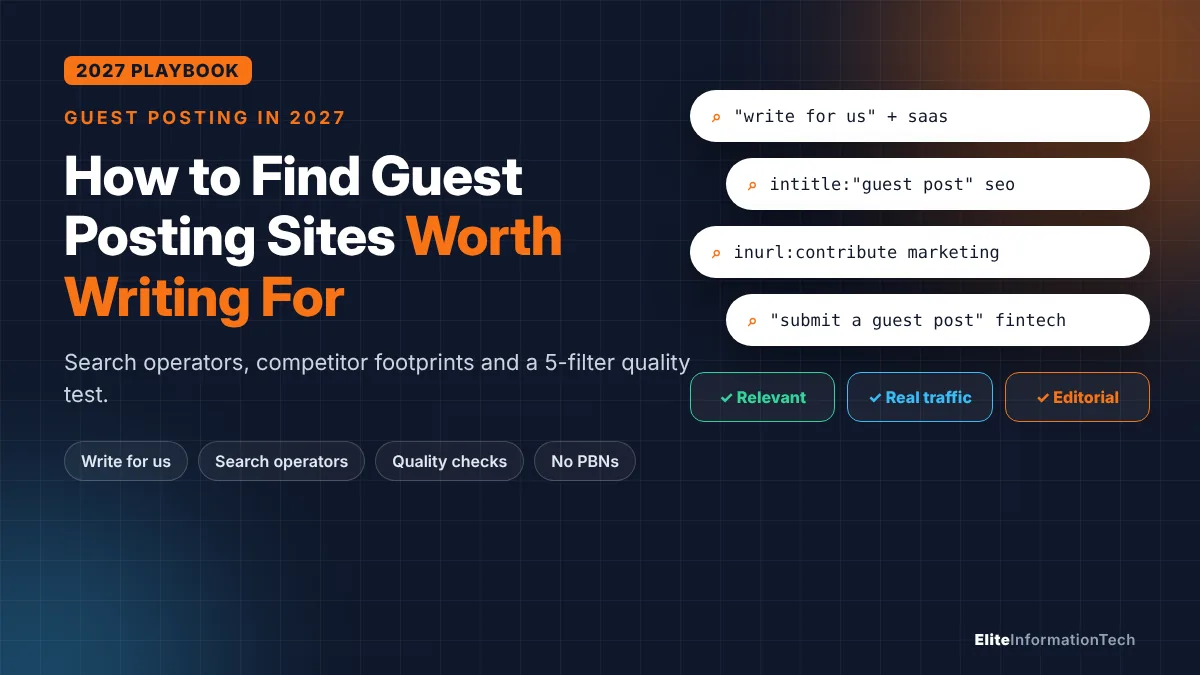
Short answer: To find guest posting sites in your niche, search Google with footprints like "write for us" + [niche], intitle:"guest post guidelines" [niche] and "guest author" [niche]; check your competitors' backlinks for guest-authored posts; and follow prolific writers in your industry to see where they contribute. Then vet every site for topical relevance, real organic traffic, editorial standards, healthy outbound links and an engaged audience before you pitch. Skip any site that sells dofollow links from a price list.
Is guest posting still worth it in 2027?
Short answer: yes, if you do it for the right reasons.
Guest posting has a reputation problem, and it earned it. Years of keyword-stuffed articles on sites built purely to sell links made Google wary. Its spam policies explicitly list "links with optimized anchor text in articles, guest posts, or press releases distributed on other sites" as an example of link spam. Its site reputation abuse policy also targets third-party content published mainly to exploit a host site's ranking signals.
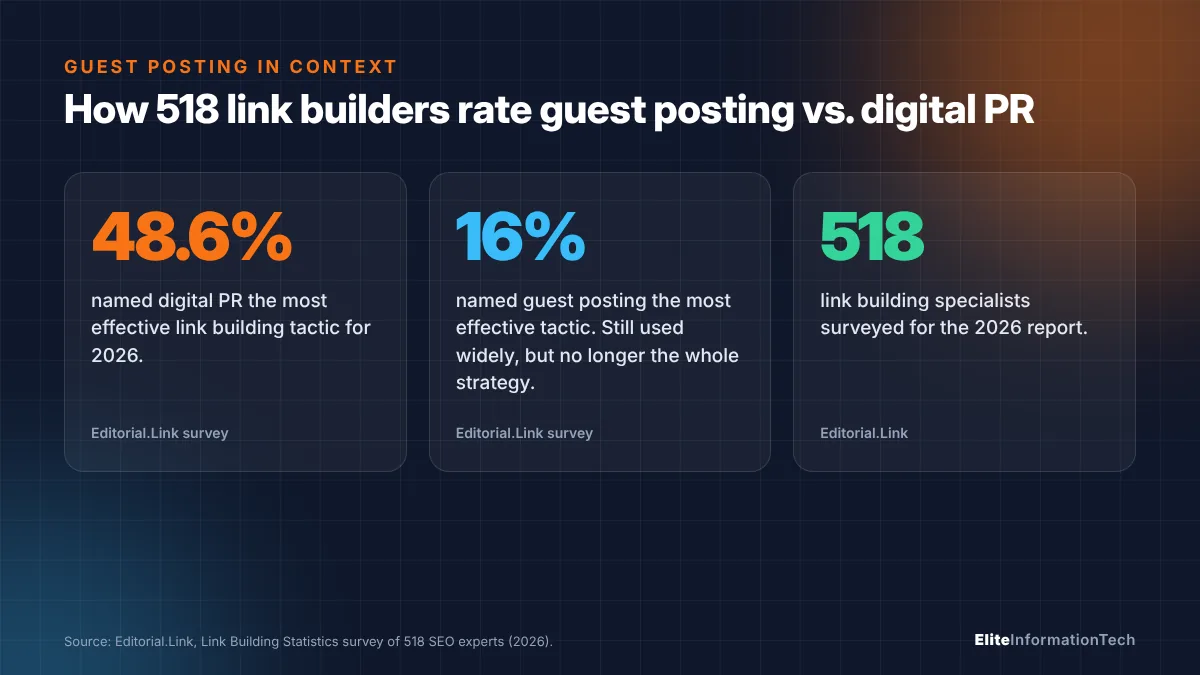
SEO practitioners have noticed. In Editorial.Link's 2026 survey of 518 link building specialists, only 16% named guest posting the most effective link building tactic, compared with 48.6% for digital PR. Guest posting hasn't disappeared, but it's increasingly seen as one channel in a broader mix rather than the whole strategy.
So why bother? Because guest posting done properly still delivers things few other tactics do:
- A real audience: your expertise in front of readers who already care about your topic.
- Authority and E-E-A-T signals: a byline on respected industry sites builds your profile as an expert.
- Brand mentions for AI search: Ahrefs found branded web mentions had a 0.664 correlation with AI Overview visibility, the strongest factor in its 75,000-brand study.
- Relevant, editorial links: when the site and the content are genuinely good.
- Relationships: editors who like your first post often invite you back or quote you elsewhere.
The shift for 2027 is simple: stop thinking "where can I get a link?" and start thinking "where do my customers read?" That question leads to better sites, and to the kind of links Google and AI tools actually value.
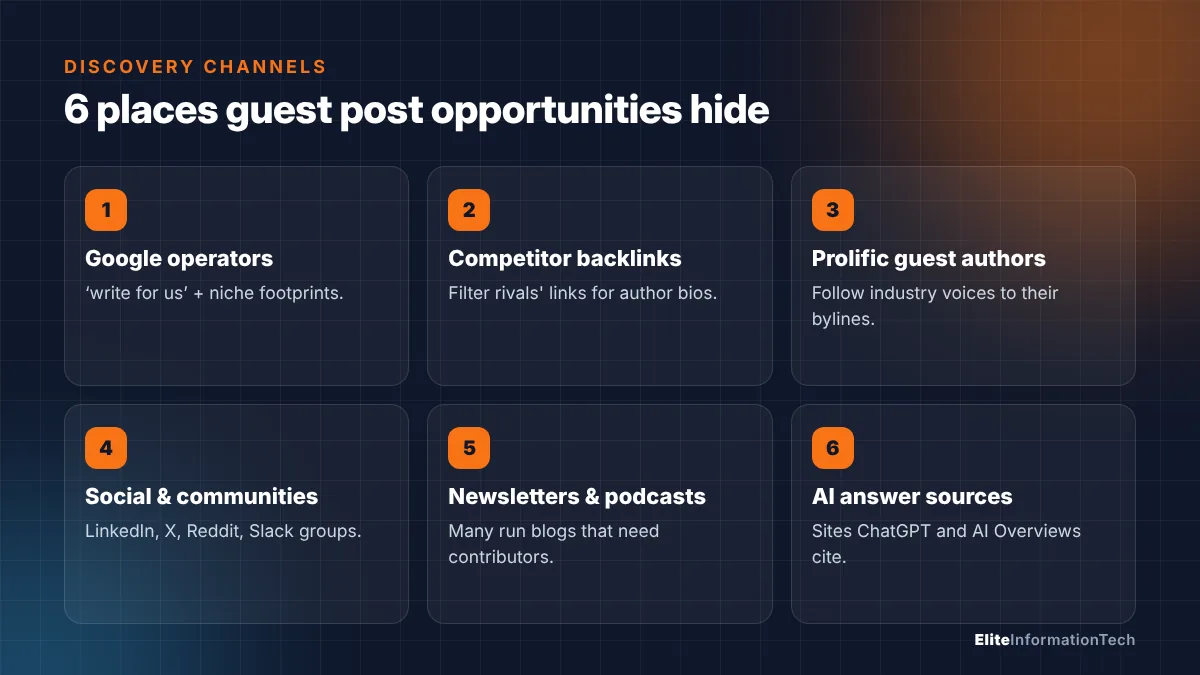
Method 1: Google search operators that actually work
Search operators are still the fastest way to find sites that openly accept contributors. The trick is to use specific sub-topics instead of broad industry terms. "write for us" + marketing returns thousands of generic sites; "write for us" + "email deliverability" returns far fewer, much more relevant ones.
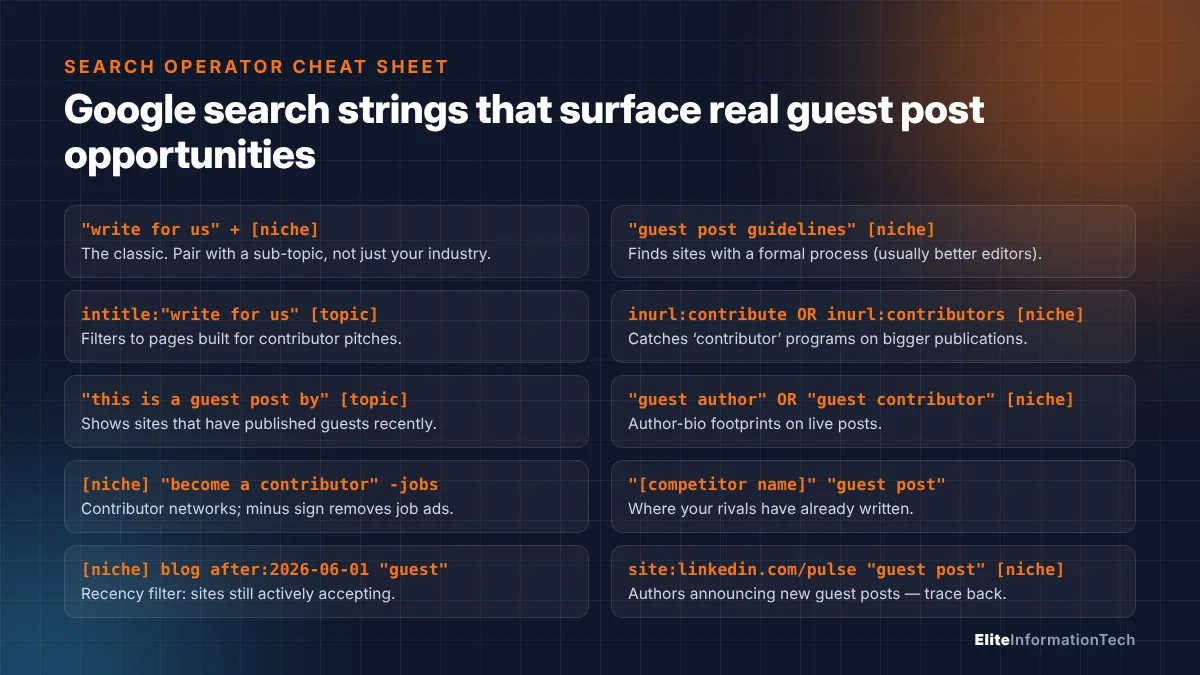
Here are 25 search strings, grouped by what they find. Replace [niche] with your topic.
Classic "write for us" footprints
"write for us" [niche]"write for us" "[niche]" -jobs -careers"guest post guidelines" [niche]"submit a guest post" [niche]"contribute" "[niche]" "guidelines""become a contributor" [niche] -jobs"accepting guest posts" [niche]
Title and URL filters (cleaner results)
intitle:"write for us" [niche]intitle:"guest post" [niche]inurl:write-for-us [niche]inurl:contribute [niche]inurl:guest-post [niche]inurl:contributors [niche]
Footprints of published guest posts
"this is a guest post by" [niche]"guest author" [niche]"guest contributor" [niche]"this post was written by" [niche]"about the author" "[niche]" "guest"
Competitor and author footprints
"[competitor brand]" "guest post""[competitor founder name]" "guest post""[known industry writer]" "contributor""[competitor brand]" -site:[competitor].com
Recency and location filters
"write for us" [niche] after:2026-06-01"guest post" [niche] India"write for us" [niche] site:.co.uk
In Google, click Tools → Any time → Past year to see only recently published guest posts. A site that published a guest post last month is far more likely to say yes than one whose "write for us" page hasn't changed since 2019.
Expect these searches to return a mix of great and terrible sites. That's fine. Operators are for finding candidates; the quality test later in this guide is for filtering them.
Method 2: Mine your competitors' backlinks
Your competitors have already done the hard work of finding guest posting sites. Their backlink profiles show you exactly where.
- Pull each competitor's referring domains in Ahrefs, Semrush or Moz.
- Filter linking pages by URL or title containing words like guest, author, contributor.
- Look for links from author bio sections, which usually sit at the bottom of the page.
- Check the anchor text: a founder's name or brand name in a bio is a strong guest post signal.
Then run a link intersect to find sites hosting guest posts from two or more competitors. Those blogs clearly accept contributors in your space. We cover this process step by step in our guide to finding your competitors' backlinks.
Say you run a cybersecurity consultancy. Filtering three competitors' backlinks for author-bio links might reveal guest posts on an IT management blog, a fintech compliance site and a small business tech publication. Each has already accepted security content from your rivals, so a fresh angle from you is an easy fit.
Method 3: Follow prolific guest authors
Every niche has a handful of people who seem to write everywhere. Their bylines are a free map of contributor-friendly sites.
- Pick 5–10 well-known writers in your field.
- Search
"[author name]" "guest post"or"[author name]" contributor. - Check their LinkedIn "Featured" section and personal site. Many list publications they've written for.
- Use their author pages on publications to discover related sites in the same network.
This method tends to surface higher-quality sites than generic operators, because established writers are picky about where their names appear.
Method 4: Social media and communities
Many good blogs never publish a "write for us" page. They find contributors through their networks instead. To tap into that:
- LinkedIn: search posts for "guest post" or "contributors wanted" plus your niche. Editors often post open calls. Follow editors of publications you'd like to write for.
- X (Twitter): advanced search for "guest post" + your niche, or "my latest guest post" to find where people are publishing.
- Reddit and niche forums: subreddits and communities about blogging, content marketing or your industry occasionally share contributor opportunities. Read the rules before posting anything.
- Slack and Discord groups: content marketing and SEO communities often have channels for contributor requests.
- Facebook groups: useful in some niches, but quality varies widely. Vet everything.
Method 5: Newsletters, podcasts and industry associations
Some of the best guest opportunities aren't labelled as guest posts at all:
- Industry newsletters with companion blogs often need expert contributors.
- Podcasts publish show notes linking to guests. They aren't technically guest posts, but they produce mentions and links on relevant sites.
- Industry associations and chambers of commerce often publish member articles and resource sections.
- SaaS company blogs in adjacent, non-competing categories frequently accept partner content.
- University and professional body blogs sometimes publish practitioner insights.
Be cautious with "contributor councils" and membership programmes that charge a fee to publish. They can be useful for visibility, but treat them as paid placements, not editorial links.
Method 6: Sites AI answers already cite
This is the newest method on the list, and still underused.
Ask ChatGPT, Perplexity, Gemini and Google's AI Mode the questions your customers ask. Note every blog or publication cited in the answers. Then check which of those sites accept contributors.
Why this matters: these sources are already shaping how AI tools describe your topic. A well-written guest post on one of them puts your brand into the material AI systems draw on. An Ahrefs analysis of 15,000 queries found that only around 12% of AI-cited URLs overlapped with Google's top 10 results — so the sites AI cites aren't always the ones you'd find through normal SEO research.
The 5-filter quality test (run it before every pitch)
Finding sites is the easy half. This is where you protect your time and your site's reputation.
| Filter | How to check | Pass if… |
|---|---|---|
| 1. Topical fit | Read the homepage and last 10 posts | Most content is about your niche or a close neighbour |
| 2. Organic traffic | Traffic graph in Ahrefs, Semrush or similar | Stable or rising trend, ranking for real topic keywords |
| 3. Editorial standards | Read three recent posts closely | Edited, sourced, named authors, a real editor |
| 4. Outbound links | Check links inside recent guest posts | Few, relevant links; no casino, pill or loan spam |
| 5. Engaged audience | Comments, shares, newsletter, social | Visible signs that real people read it |
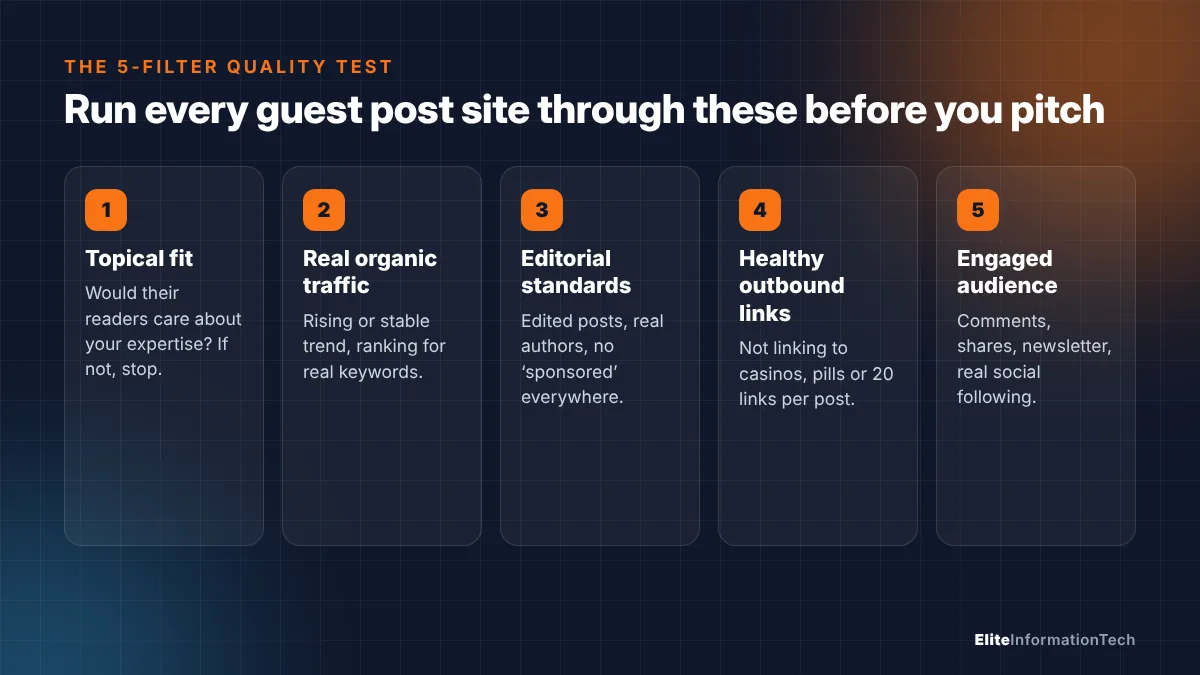
Filter 1: Topical fit
Would this site's readers genuinely care about what you know? A dental marketing agency writing for a dentistry blog makes sense. The same agency writing for a general "business tips" blog that also covers fashion and crypto doesn't. Relevance is the single biggest factor in whether a guest post helps you.
Filter 2: Real organic traffic
Check the site in Ahrefs, Semrush or a similar tool. You want a stable or rising traffic trend and rankings for real keywords, ideally ones related to your topic. A site with a high DR but almost no traffic is a classic warning sign. So is a traffic chart that spiked and then collapsed, which often follows a Google update.
Filter 3: Editorial standards
Read three recent posts. Are they edited? Do they have real authors, sources and images? Is there a named editor? If posts read like they were spun or generated in bulk, your article will sit in bad company.
Filter 4: Healthy outbound links
Look at where existing guest posts link. If every article has several unrelated commercial links (casinos, pills, payday loans), the site is likely selling links. Google can discount links from these sites, and your brand appears next to theirs.
Filter 5: An engaged audience
Comments, shares, a newsletter, an active social following, mentions elsewhere online. These signals tell you real people read the site, which is what turns a guest post into referral traffic and brand recognition.
Red flags vs. green flags
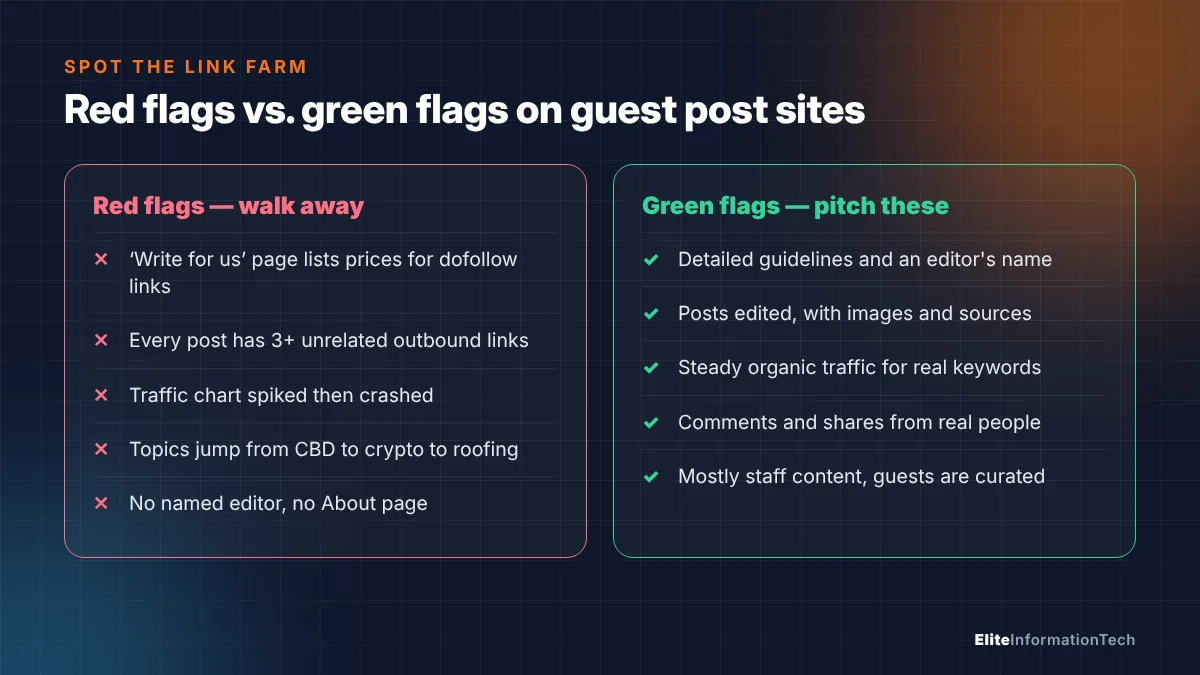
| Red flags: walk away | Green flags: pitch these |
|---|---|
| Price list for dofollow links on the "write for us" page | Detailed guidelines and a named editor |
| Several unrelated outbound links in every post | Posts are edited, with images and sources |
| Traffic spiked, then crashed | Steady organic traffic for real keywords |
| Topics jump from CBD to crypto to roofing | Clear topical focus |
| No About page or named team | Mostly staff content, with curated guest posts |
A few more red flags worth knowing:
- "Write for us" pages that mention dofollow, DA or price in the first paragraph.
- Huge numbers of indexed pages on a site with little traffic.
- Guest posts that are clearly unrelated to the site's main topic.
- Promises to publish "within 24 hours" with no editing.
- The same "editor" email appearing across dozens of different sites (a sign of a link network).
Many sites now charge for guest posts, and prices range from a few dollars on link farms to hundreds or thousands on real publications. A cheap price is usually a warning sign, not a bargain. Under Google's spam policies, paid content that includes links passing ranking credit is link spam unless the links are marked rel="sponsored" or rel="nofollow". If you pay for visibility, label it properly.
A 60-minute workflow: from zero to 20 vetted prospects
Here's how to put all six methods together in a single focused session. Set a timer so research doesn't eat the whole afternoon.
- Minutes 0–10: define three sub-topics. Not "marketing" but "B2B email deliverability", "SaaS onboarding emails" and "cold email compliance". Specific sub-topics produce specific, relevant sites.
- Minutes 10–25: run operators. Use five or six strings from the list above for each sub-topic, filtered to the past year. Paste every promising domain into your sheet without judging yet.
- Minutes 25–35: mine competitor backlinks. Filter two or three competitors' links for author bios and guest bylines. Add those domains.
- Minutes 35–40: check AI answers. Ask two or three AI tools your customers' key questions and add any cited blogs that might accept contributors.
- Minutes 40–60: run the 5-filter test. Spend roughly a minute per site. Be ruthless. A typical session turns 60–80 raw domains into 15–25 sites worth pitching.
Repeat this once a month and you'll always have fresh prospects. Over time, the "found via" column in your sheet will show you which method produces the best sites in your niche, so you can spend more time there.
Guest posting for local and international businesses
Where your customers are should shape where you write.
- Local businesses get more from regional publications, city blogs, local business associations and chamber of commerce sites than from big national blogs. Add your city or region to your operators:
"write for us" [niche] Mumbaior"guest post" [niche] "Sydney". - Businesses selling into several countries should build separate lists per market. A strong UK-based industry blog does more for UK visibility than a generic global one. Use country-code domains with
site:.co.uk,site:.com.auorsite:.ca. - Non-English markets often have far less competition for guest contributions. If you can write well (or work with a native writer), these opportunities can be surprisingly accessible.
Should you use a ready-made "guest posting sites list"?
Search for "guest posting sites list" or "free guest posting sites" and you'll find lists of hundreds of blogs, often sorted by DA. They're tempting. They're also usually a waste of time, for three reasons:
- Everyone else has the same list. Editors on those sites get flooded with pitches, and the good ones stop accepting guests.
- Many are link farms. Public lists attract sites that exist to sell links, which is exactly what you want to avoid.
- They're rarely relevant. A list of "500 high DA sites" is sorted by a metric, not by your customers' interests.
Use public lists only as a starting point for ideas, and run every site through the 5-filter test. A list you build yourself, around your sub-topics, will always be stronger.
Using Ahrefs Content Explorer to find guest authors
If you have Ahrefs, Content Explorer is a fast way to find where guest content is being published. Search your topic and filter by author, or search for well-known writers in your niche to see every site that's published their work. Sort by organic traffic and you'll quickly see which contributor-friendly sites actually get read.
Guest post vs. sponsored post
A guest post is accepted on editorial merit: the editor publishes it because it's useful for their readers. A sponsored post is paid content. Both can be legitimate, but sponsored posts should be clearly labelled, and links in them should use rel="sponsored" or rel="nofollow" under Google's guidelines.
How to organise your guest posting list
A simple spreadsheet keeps your list useful for months. Suggested columns:
| Column | Why it matters |
|---|---|
| Site + URL of guidelines | Quick access when you pitch |
| Topic / sub-niche | Group sites for targeted pitches |
| Organic traffic + trend | Prioritise healthy sites |
| Quality score (0–5) | One point per filter passed |
| Editor name + email | Pitch the right person |
| Link policy | Dofollow, nofollow, bio only, paid |
| Found via | Learn which method finds the best sites |
| Status + date | Pitched, accepted, published, follow-up |
Only pitch sites scoring 4 or 5. Keep the rest in a backlog. Sites improve, editors change, and a "maybe" today might be a "yes" next year.
Pitch and write guest posts that get accepted
Once you have a clean list, the pitch decides everything. Our full guide on link building outreach that gets replies covers subject lines, follow-ups and templates in detail. For guest posts specifically:
- Read the guidelines and follow them exactly. It's the easiest way to stand out.
- Find a content gap. Search
site:theirdomain.com [topic]to see what they've already covered, then pitch an angle they haven't. - Pitch 2–3 specific titles with a one-line summary each, not a vague "I'd love to write for you".
- Show you can write. Link to one or two published articles you're proud of.
- Bring something original. Data, a case example, a framework or a strong opinion from real experience.
Guest post angles editors rarely turn down
- "What we learned from…" posts based on real projects, with numbers.
- Contrarian takes backed by evidence: "Why [common advice] doesn't work for [specific audience]".
- Step-by-step processes with screenshots or templates readers can use right away.
- Updates to classic topics that have changed because of AI search or new regulations.
- Small original surveys of your customers or community, even 100 responses.
Writing a guest post that helps SEO and GEO
When the editor says yes, write as if it's going on your own site, or better:
- Lead with a direct answer to the core question in the first paragraph. AI tools and featured snippets favour clear, extractable answers.
- Use specific numbers and sources. Cited data is more likely to be quoted.
- Link to useful resources, including other sites, not just your own.
- Keep your own link natural: usually your brand name or a descriptive phrase, in the bio or where it genuinely helps the reader.
- Write a strong author bio with your real name, role and expertise. Consistent bios across sites help both readers and AI systems understand who you are.
Guest posting mistakes to avoid in 2027
- Chasing DA or DR alone. Third-party scores are easy to inflate. Traffic and relevance are harder to fake.
- Using exact-match anchors. Explicitly called out in Google's spam policies.
- Publishing the same article on several sites. Duplicate content helps no one.
- Writing thin, generic AI content. Editors can tell, and good sites will reject it.
- Ignoring nofollow opportunities. A nofollow guest post on a site your customers read can be worth more than a dofollow link nobody sees.
- Never promoting the post. Share it, link to it from relevant places, and thank the editor. It builds the relationship for next time.