
Key takeaways
- Most outreach fails before the email is written, at the asset and prospecting stage.
- Smaller campaigns win: BuzzStream saw reply rates fall 68% from 1–50-email campaigns to 1,001–5,000-email blasts.
- Fake personalisation ("Loved your recent post!") performs worse than none at all.
- Subject lines of 36–50 characters performed best in the Backlinko data, and personalised subjects lifted replies by 30.5%.
- Never pay for links that pass ranking credit. Decline politely or ask for rel="sponsored".
Link building outreach is the process of contacting website owners, editors and journalists to earn links and mentions for your content. It's also where most link building campaigns quietly fail. You found 200 perfect prospects. You wrote a solid template. You hit send, refreshed your inbox for a week, and got four replies. Two said no, one asked for $250, and one was an out-of-office message from 2025.
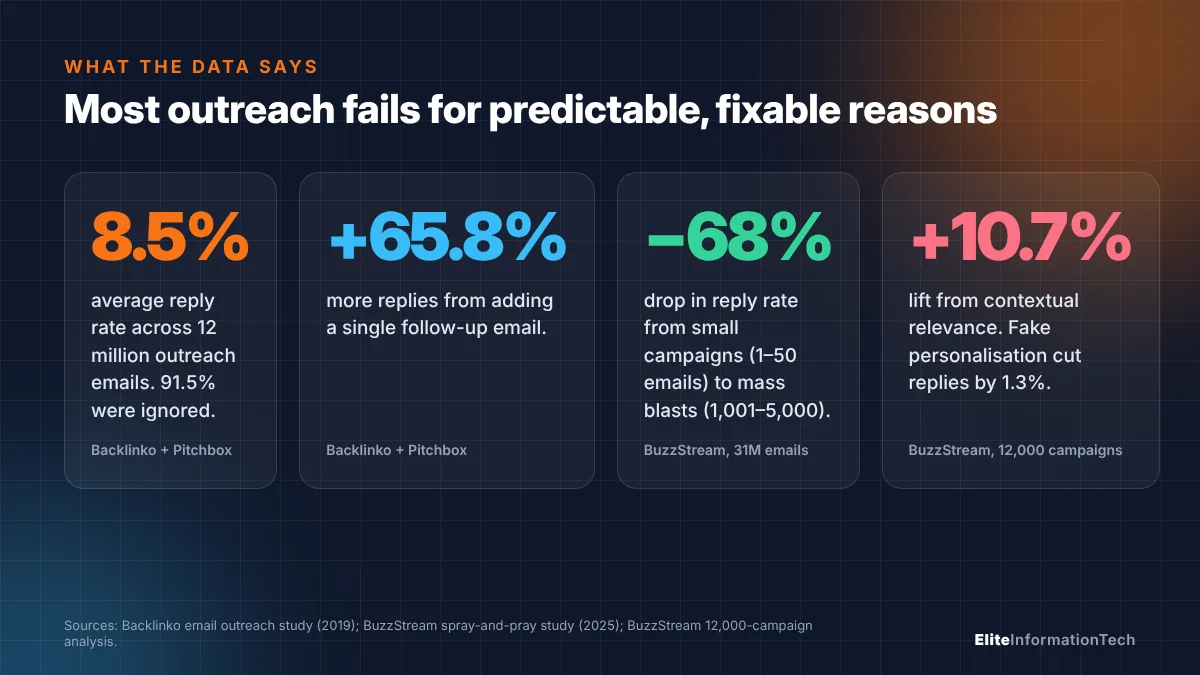
If that sounds familiar, it's normal. When Backlinko and Pitchbox analysed 12 million outreach emails in their 2019 study, only 8.5% got any reply at all. That's 91.5% ignored. Inboxes have only got more crowded since.
But that average hides a huge spread. BuzzStream's analysis of 12,000+ campaigns found the median account got around a 12% reply rate, while the top 5% consistently hit 40% or more. Same industry, same kinds of prospects, very different results.
This guide is about what that top 5% does differently. We'll cover prospecting, subject lines, the four-part email structure, copy-and-adapt templates, follow-ups, deliverability, and how to use AI in 2027 without sounding like every other bot in the inbox.
Short answer: Link building outreach that gets responses follows five rules: (1) pitch something genuinely link-worthy, (2) email small, well-researched lists of relevant sites, (3) personalise with a real detail from the recipient's work, not a fake compliment, (4) keep the email short with one clear, easy ask, and (5) send one to three polite follow-ups. Research shows one follow-up lifts replies by 65.8%, contacting several people at one site lifts replies by 93%, and contextual relevance beats generic personalisation.
What the outreach data actually says
Before tactics, a reality check. Here's what the biggest public studies on outreach emails found. Some of this data is a few years old, but no larger public datasets have replaced it, and the patterns still hold.
Two more findings matter even more:
- Volume kills replies. BuzzStream studied 31 million emails across 86,000 campaigns. Campaigns of 1–50 emails averaged a 1.15% reply rate; campaigns of 1,001–5,000 averaged 0.37%. (These were mostly digital PR pitches to journalists, which run much lower than link building outreach, but the pattern is the point.)
- Bad personalisation is worse than none. In BuzzStream's 12,000-campaign analysis, "fake personalisation" reduced replies by 1.3%, while genuine contextual relevance lifted them by 10.7%.
Put simply: fewer, better emails to the right people beat bigger lists almost every time.
Why most outreach gets ignored (a view from the other inbox)
Picture the person you're emailing. She edits a mid-sized marketing blog. Her inbox gets dozens of pitches a week, and in 2027 a growing share are clearly machine-written: same structure, same "I hope this email finds you well", same suspiciously warm praise for an article she wrote in 2021.
She isn't looking for reasons to say yes. She's looking for reasons to hit delete. The most common ones:
- It's irrelevant. A pitch for a roofing guide to a SaaS blog.
- It's all take. "Please add my link" with nothing in return for her readers.
- It's obviously a template. "Dear Webmaster" or a merge field gone wrong.
- It's too long. Four paragraphs before she knows what you want.
- The thing being pitched isn't good. No email can fix that.
Every step below is designed to remove one of those reasons.
Step 1: Pitch something worth linking to
No email, however clever, will earn a link to a page that doesn't deserve one. Before outreach, ask: why would a busy editor link to this instead of the five other pages on the same topic?
Pages that earn links in 2027 usually have at least one of these:
- Original data: a survey, benchmark, or analysis of your own customer data (anonymised).
- A useful tool: calculator, checker, template, generator.
- Genuine expertise: practitioner insight AI-generated content can't fake.
- The best visual explanation: a diagram or chart people will want to embed.
- Freshness: the only up-to-date resource on a topic that changed recently.
Not sure what your niche rewards? Look at which competitor pages have the most referring domains. Our guide to finding your competitors' backlinks shows how to spot those linkable assets in minutes.
Step 2: Prospect like the top 5%
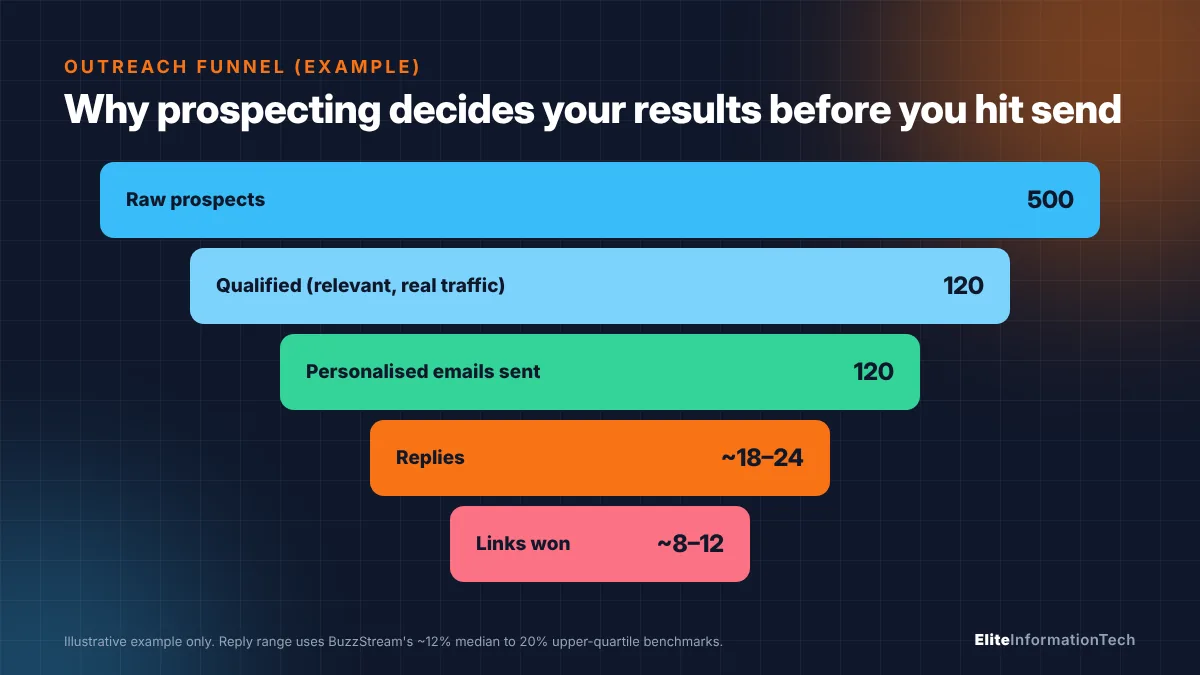
BuzzStream's analysis found the most common difference between top performers and everyone else wasn't writing skill. It was that they spend most of their time researching and qualifying prospects. The email gets easier when you know exactly who you're writing to.
Good prospect sources:
- Sites linking to two or more of your competitors (a backlink gap list).
- Pages linking to an older or weaker version of your resource.
- Resource pages and "best tools" roundups in your niche.
- Blogs that accept contributors (see our guide on how to find guest posting sites in your niche).
- Journalists and creators who've covered your topic recently.
- Sources that ChatGPT, Perplexity and Google's AI Overviews cite for your topic.
Then qualify every prospect with three quick checks: Is it relevant? Does it get real organic traffic? Has it published or updated content in the last six months? If any answer is no, cut it.
Instead of one list of 500, build five lists of 30–60 grouped by why they'd care: resource pages, broken-link pages, people who quoted similar data, and so on. Each list gets its own angle. This is how you stay personal at scale.
Step 3: Find the right person (not info@)
Emails to generic inboxes rarely reach the person who can edit the page. Look for:
- The author of the specific article (byline, author page).
- The editor or content lead for blogs and publications.
- The site owner for small blogs and niche sites.
Tools like Hunter, Snov.io, Apollo and the email finders built into Pitchbox and BuzzStream help, but always verify the address before sending, because bounces hurt deliverability. LinkedIn is useful for confirming that someone still works there.
For important prospects, identify two or three relevant contacts. Backlinko found that contacting multiple people at the same organisation increased response rates by 93%. Email them in sequence, not all at once, so nobody gets three identical pitches in the same minute.
Step 4: Write subject lines that get opened
Your subject line has one job: make the right person curious enough to open. In the Backlinko data, subject lines of 36–50 characters performed best, and personalised subject lines lifted replies by 30.5%.
| Weak subject line | Better (and why) |
|---|---|
| Link request | Your SEO tools list + one free option it's missing (specific, useful) |
| Collaboration opportunity | Guest post idea for your Shopify readers (clear and relevant) |
| Quick question | Broken link on your crawl budget guide (a real problem to fix) |
| Great article!! | 2026 salary data for your hiring guide (new value) |
Avoid clickbait. A subject that over-promises gets opened once, then marked as spam.
Step 5: The four-part email that gets replies
Most outreach that works follows the same simple structure. We aim for under 125 words: long enough to be human, short enough to read on a phone between meetings.
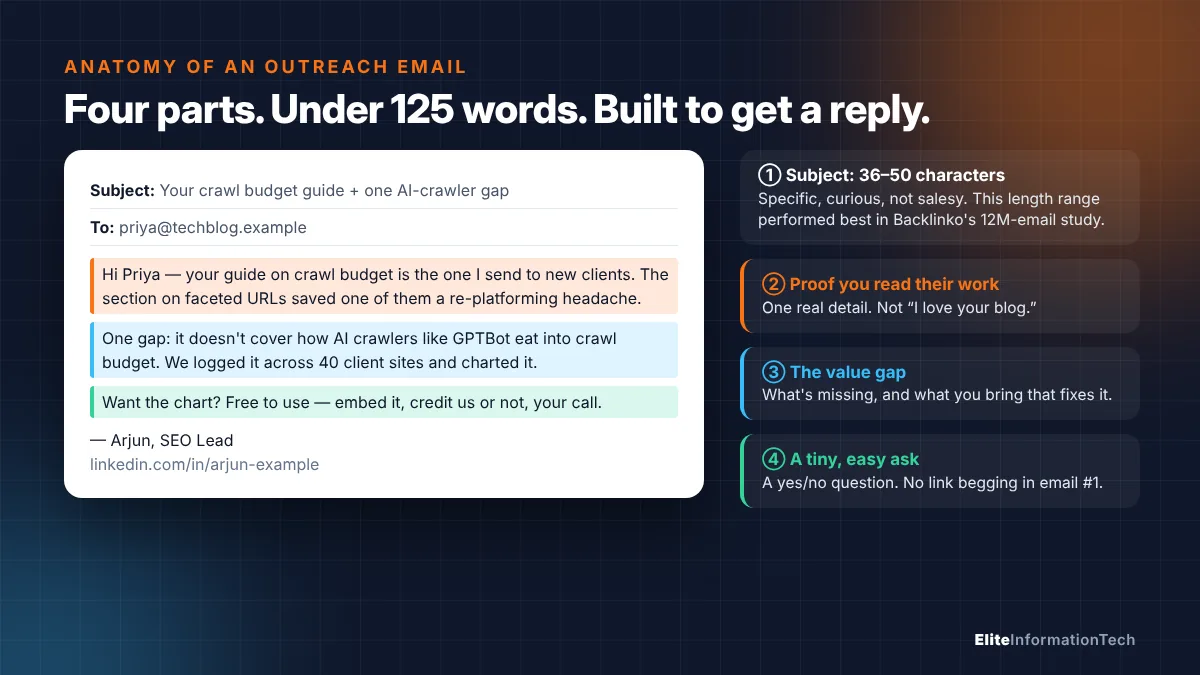
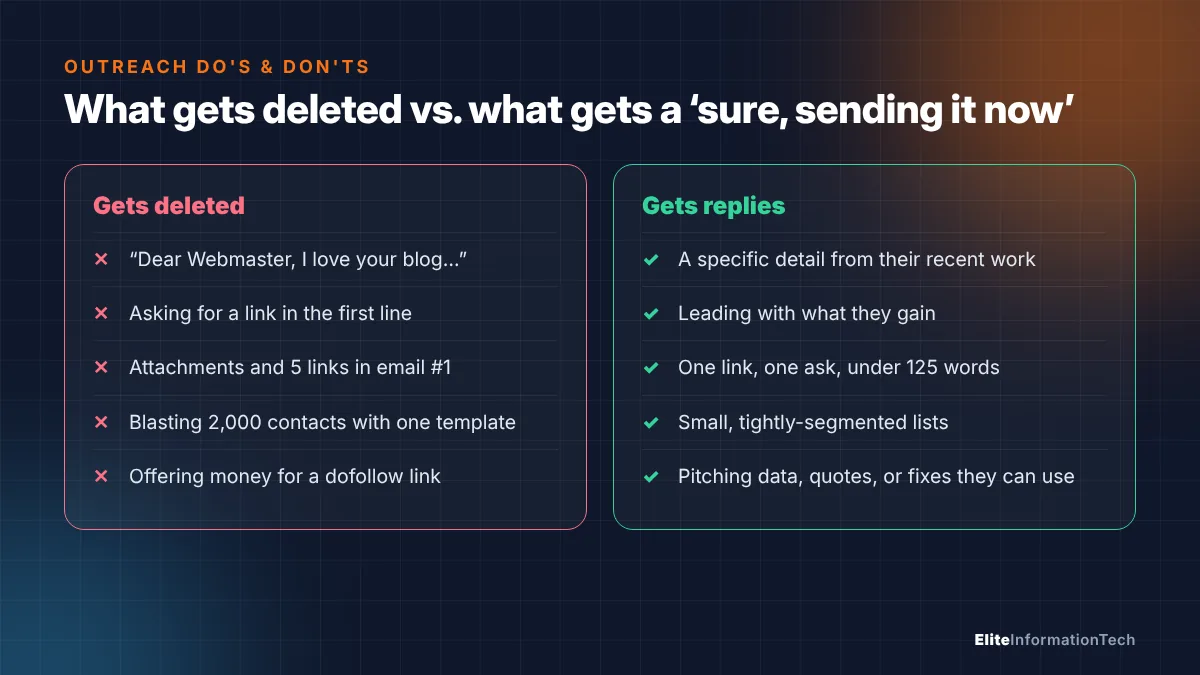
- Proof you actually read their work. One real, specific detail. Not "I loved your article", but "your section on faceted URLs saved one of our clients a re-platforming headache."
- The value gap. What's missing, outdated or broken on their page, and what you have that fixes it.
- Why you're credible. One line, maximum. Your role, a data point, or a recognisable client type.
- A tiny, easy ask. A yes/no question: "Want me to send it over?" works better than "Please add my link to your page."
About personalisation: remember BuzzStream's finding. "Fake" personalisation — flattering but generic lines — actually lowered replies. What works is contextual relevance: showing why this email is going to this person about this page. If you can't find a genuine reason, the prospect probably shouldn't be on your list.
6 link building outreach email templates for 2027
Treat these as skeletons, not scripts. Copy the structure, then rewrite every line for the person you're emailing.
1. Resource page outreach
Subject: A free [tool type] for your [topic] resources page
Hi [Name],
I was going through your [topic] resources page — the note on [specific item] is exactly how I'd explain it to a new client.
We recently built a free [tool/guide] that does [specific outcome] without a sign-up. It might be a useful addition next to [similar resource on their list].
Happy to send a quick summary if you'd like to check it out first?
[Your name], [Role] at [Company]
2. Broken link building
Subject: Broken link in your [article title] guide
Hi [Name],
Quick heads-up: the link to [resource] in your section on [subtopic] now returns a 404.
If you need a replacement, we keep an updated guide on the same topic here: [URL]. No worries if you'd rather pick another source — just thought you'd want to know.
[Your name]
3. Unlinked brand mention
Subject: Thanks for mentioning [Brand] in your [topic] article
Hi [Name],
Thanks for including [Brand] in your piece on [topic]. Really appreciated the way you framed [specific point].
Would you be open to linking our name to [URL] so readers can find us easily? Either way, thanks for the mention.
[Your name]
4. Guest post pitch
Subject: Guest post idea: [specific, curiosity-driven title]
Hi [Name],
I've been following your posts on [topic] — [specific post] covered [point] better than anything else I've read.
One angle I haven't seen on your blog yet: [proposed title]. It would cover [2–3 concrete points], using [data/experience you bring].
I've written for [1–2 relevant publications]. Want me to send a short outline?
[Your name]
5. Data / digital PR pitch
Subject: New data: [headline finding in one line]
Hi [Name],
Saw your recent piece on [topic]. We just analysed [dataset] and found [surprising finding with a number].
Full methodology and charts are here: [URL]. Free to use with credit. I can also share a quote from [expert] if useful.
[Your name]
6. Roundup / "best X" inclusion
Subject: A [category] option for your 2027 roundup
Hi [Name],
Your list of [best X tools] is one of the clearest I've read. If you update it this year, [Product] might be worth a look for [specific audience], mainly because [one clear differentiator].
Happy to set up a free account so you can test it yourself.
[Your name]
Pick one angle per prospect, the one that genuinely fits their page. Multiple pitches with different hooks look desperate, and editors talk.
Step 6: Follow up without being annoying
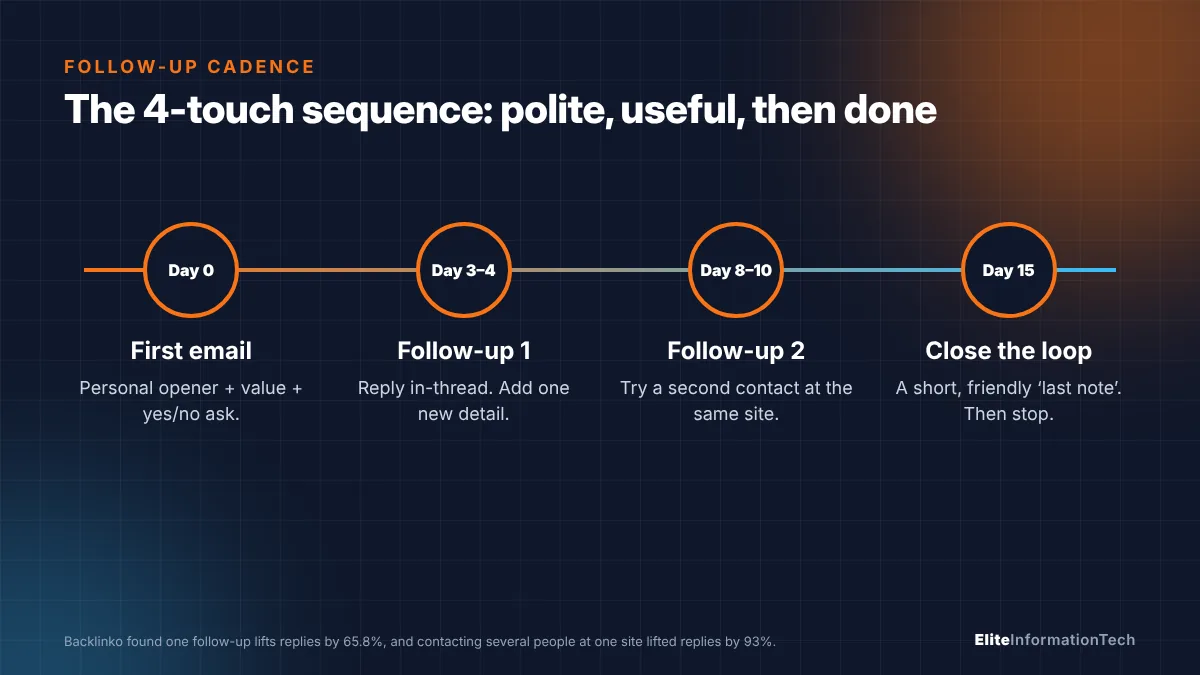
Most people send one email and give up. That's leaving a lot of replies on the table: in the Backlinko data, one follow-up lifted replies by 65.8%, and sequences of three or more messages had the best overall response rate.
A follow-up that works:
Subject: Re: [original subject]
Hi [Name], just bumping this in case it got buried. Since my last note, we've also added [one new useful thing — a chart, an updated stat]. Worth a look?
Rules for follow-ups:
- Reply in the same thread so context stays visible.
- Add something new each time. Never just "Did you see my email?"
- Stop after three or four touches, and remove anyone who says no.
Step 7: Timing and deliverability
Timing matters a little; deliverability matters a lot.
Timing: Backlinko found weekday emails got 23.3% more replies than weekend emails, with a slight edge for Wednesday. Don't overthink it. Send during the recipient's working hours in their time zone.
Deliverability: If your emails land in spam, nothing else in this guide matters. Since 2024, Gmail and Yahoo have required senders to authenticate their mail, with stricter rules for bulk senders. At minimum:
- Set up SPF, DKIM and DMARC on the domain you send from.
- Warm up new sending accounts slowly; don't go from 0 to 200 emails a day.
- Verify every address to keep bounces low.
- Avoid link-heavy emails and attachments in first touches.
- Keep daily volume per inbox modest, and spread campaigns across days.
- Keep spam complaints low. Google advises bulk senders to stay under a 0.3% spam rate, and Microsoft began enforcing similar authentication rules for high-volume Outlook senders in May 2025.
Step 8: Handle replies (including "that'll be $300")
Replies come in a few flavours. Here's how to handle each:
- "Sure, send it over." Respond fast, ideally the same day. Make it easy: exact URL, suggested placement, and the snippet of text if relevant.
- "Not right now." Thank them and ask if you can check back when they update the article. Note it in your CRM.
- "We charge $X for links." Very common. Under Google's spam policies, paying for links that pass ranking credit is link spam. Either decline politely, or if it's genuinely worth it for exposure, ask for the link to be marked rel="sponsored".
- "Let's do a link exchange." Occasional, natural cross-linking between relevant sites is normal. Systematic swaps (including three-way "ABC" exchanges) are what Google calls excessive link exchanges. Say yes only when the link genuinely helps your readers.
- "Can you write a guest post instead?" Often a great outcome. Agree on the topic first and write something that serves their readers, not just your keywords.
- No reply after the full sequence. Move on. A prospect who never replies may still be worth a different angle in six months.
Best link building outreach tools in 2027
You can run outreach from Gmail and a spreadsheet. Once you're sending more than a few dozen emails a month, a dedicated tool saves hours and keeps follow-ups from slipping.
| Tool | Best for | Notes |
|---|---|---|
| Pitchbox | Agencies running many campaigns | Prospecting, sequences and reporting in one place |
| BuzzStream | Relationship-led outreach and digital PR | Strong contact history and team collaboration |
| Respona | All-in-one prospecting and outreach | Built-in search for prospects and contacts |
| Hunter | Finding and verifying email addresses | Also offers simple sending campaigns |
| Lemlist / Instantly | Cold email sequences at scale | Deliverability and warm-up features |
| Qwoted / Featured | Expert quotes for journalists | Popular alternatives to the old HARO model |
Link building outreach vs. blogger outreach: the terms overlap. Blogger outreach usually means working with bloggers and creators on reviews, mentions or sponsored content. Link building outreach focuses on earning editorial links. The same principles apply to both: relevance, value and honesty about anything paid.
Using AI in outreach without sounding like AI
AI tools are now part of almost every outreach workflow. That's fine. The problem is that recipients have become very good at spotting AI-written pitches, and an email that "feels generated" gets deleted on sight.
Where AI genuinely helps:
- Summarising a prospect's recent articles so you find a real hook faster.
- Grouping prospects into segments by topic or page type.
- Drafting variations of subject lines to test.
- Checking your email for length and clarity.
Where it hurts:
- Auto-generated compliments ("Your insightful article really resonated with me").
- Fully automated sending with no human review.
- Generic phrasing that every other pitch also uses.
Let AI speed up the research. Keep a human in charge of what actually gets said.
One campaign, start to finish: a worked example
Here's how the pieces fit together in a single campaign. (This is an illustrative example, not a client case study.)
The business: a Pune-based accounting software company. The asset: a free GST late-fee calculator, plus a short guide explaining how the penalties work.
- Prospecting (day 1–2). The team pulls a backlink gap list against three competitors and finds 140 sites linking to rival calculators or GST guides. After checking relevance, traffic and recent activity, 46 remain.
- Segmenting. They split the 46 into three micro-lists: 19 resource pages for small businesses, 15 articles that link to an outdated government PDF or a dead tool, and 12 accounting blogs that accept contributors.
- Writing. Each list gets its own template: "free tool for your resources page", "broken link fix", and "guest post idea on GST penalties". Every email then gets one personal line written by a human after reading the page.
- Sending. Emails go out Tuesday to Thursday in small batches, during Indian business hours for Indian sites and local hours for overseas ones.
- Following up. Two follow-ups, each adding something new: a worked example for a common filing scenario, then an embeddable version of the calculator.
The broken link list will almost always convert best, because it solves an existing problem. The guest post list converts slowest but produces the strongest links. That pattern holds across most niches — which is why running several small, angle-specific lists beats one giant campaign.
Turn one-off asks into relationships
The top performers in BuzzStream's data also did something less glamorous: they kept their contact databases current and reused relationships, referencing past collaboration in new pitches. That reference lifted replies a further 2.3% on top of contextual relevance.
Practical ways to do this:
- Share and comment on editors' work when you genuinely find it useful, not only when you need something.
- Send a thank-you when a link goes live, and tell them how their readers responded if you can see referral traffic.
- Offer expert quotes or data for their future articles, with no link request attached.
- Keep notes: what they cover, what they've accepted, what they've declined.
Six months later, your "outreach" becomes a friendly email to someone who already knows your name. That's how the top 5% get their reply rates.
Metrics that matter
Reply rate alone can fool you. Track the full funnel:
| Metric | What it tells you | Rough benchmark |
|---|---|---|
| Reply rate | Are your targeting and copy working? | ~12% median, 20%+ upper quartile (BuzzStream) |
| Positive reply rate | Is your offer genuinely useful? | Track your own baseline |
| Link conversion rate | Links won ÷ emails sent | Track by campaign type |
| Referring domain quality | Are links relevant and from real sites? | Traffic + relevance, not DR alone |
| Cost / time per link | Is the campaign efficient? | Compare against your other channels |
Compare campaigns against each other, not against generic industry numbers. A broken link campaign and a digital PR campaign will never have the same reply rate, and they shouldn't.
The GEO angle: outreach for AI visibility
In 2027, outreach isn't only about links that move Google rankings. It's also about getting your brand mentioned on the sites AI tools rely on. Ahrefs' study of 75,000 brands found branded web mentions had the strongest correlation with appearing in AI Overviews (0.664), well ahead of backlink count.
That changes who you pitch and what you ask for. Roundups, comparison articles, expert quote requests, podcasts and community discussions can all shape how AI tools describe your category, even when the mention isn't a dofollow link. Our GEO service combines link building with this kind of mention-focused outreach.