
Key takeaways
- Analyse the competitors who outrank you and the sites AI answers cite, not only your business rivals.
- Work with referring domains, not raw backlink counts. One site linking 4,000 times is still one vote.
- The backlink gap (sites linking to 2+ rivals but not you) is the highest-converting list you'll build.
- Study which competitor pages earn links. Those page types tell you what to create next.
- In 2027, unlinked brand mentions matter too: Ahrefs found branded web mentions correlate more strongly with AI Overview visibility than backlinks do.
You wrote the better article. It's longer, newer, and it actually answers the question. Yet a competitor's thin, three-year-old page still sits above you on Google, and now it's the one ChatGPT and Google's AI Overviews quote too. There's usually a reason, and you can find it in about an hour.
Nine times out of ten, the gap isn't your content. It's the links and mentions pointing at their site that don't point at yours. The good news: those links are public. With the right tools and a bit of method, you can see exactly who links to your competitors, why they did it, and which of those links you can realistically win for yourself.
This guide walks you through the exact process we use for competitor backlink analysis in 2027: free and paid options, a backlink gap method you can run in an afternoon, and a triage system so you don't waste weeks chasing links that will never move the needle.
Short answer: To find your competitors' backlinks, enter their domain into a backlink checker such as Ahrefs Site Explorer, Semrush Backlink Analytics or Moz Link Explorer and open the referring domains report. Then run a link intersect (backlink gap) analysis to list sites that link to two or more competitors but not to you. Those sites already link to your topic, which makes them the easiest links to win. Free options include Ahrefs' free backlink checker (top 100 links), limited free Semrush and Moz accounts, and Google search operators for finding brand mentions.
Why competitor backlinks matter more in 2027, not less
People have been calling links "dead" for at least a decade. The data keeps saying otherwise.
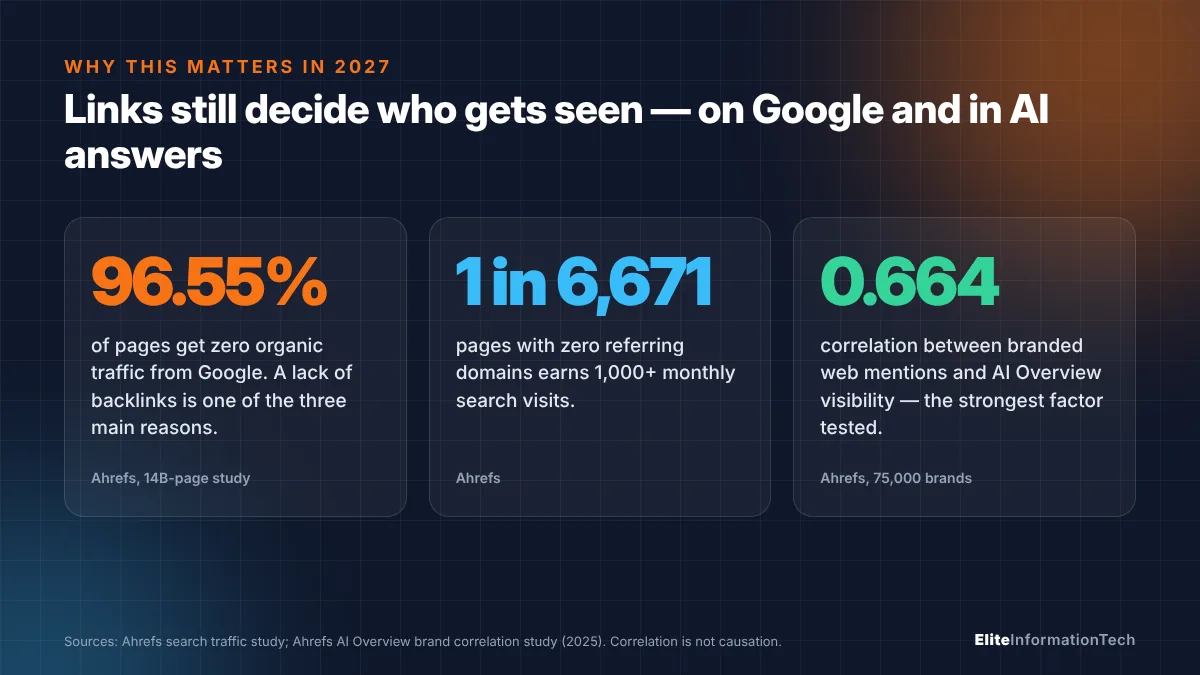
Ahrefs' study of roughly 14 billion pages found that 96.55% of pages get zero organic traffic from Google. When they dug into why, a lack of backlinks was one of three main reasons (the other two: no search demand, and content that doesn't match search intent). Of the ~20 million pages in their index with no referring domains, only 2,997 got more than 1,000 monthly search visits. That's about 1 in 6,671.
AI search has since changed where those clicks go. Pew Research found that Google users who saw an AI summary clicked a traditional result just 8% of the time, versus 15% when there was no summary. Fewer clicks are up for grabs, so being one of the sources the AI chooses matters more than ever.
And what do AI systems seem to lean on? In Ahrefs' analysis of 75,000 brands, the factor most correlated with appearing in Google's AI Overviews was branded web mentions (0.664), followed by branded anchors (0.527). Referring domains (0.295) and backlink count (0.218) came in much lower. Correlation isn't proof of cause, but the pattern is hard to ignore: the web talking about you, linked or not, is what gets you picked.
Here's why that makes competitor analysis so useful. Your competitors have already done years of trial and error. Their backlink profiles show you which sites in your niche link out, which content formats earn mentions, and which publications AI engines trust. You don't have to guess where to start.
A competitor's backlink profile shows what your industry actually links to, which is often very different from what it says it values.
Step 1: Pick the right competitors (most people get this wrong)
The instinct is to analyse your biggest business rival. That's often a mistake. A giant brand earns links because it's a giant brand: news coverage, investor press, a famous CEO. You can't copy that.
Instead, build a list of three kinds of competitors:
- Search competitors. Google your 5–10 most valuable keywords and note which domains keep showing up in the top 10. These are the sites Google is actually choosing over you. Tools like Ahrefs' "Organic competitors" and Semrush's "Competitors" report speed this up.
- Peer competitors. One or two sites at roughly your authority level that rank well anyway. Their links are the most realistic to replicate.
- AI-answer competitors. Ask ChatGPT, Perplexity, Gemini and Google's AI Mode the questions your buyers ask ("best payroll software for small teams in India", "how to fix crawl budget issues"). Write down every domain cited. These sources shape how AI describes your category, so they belong on your prospect list too.
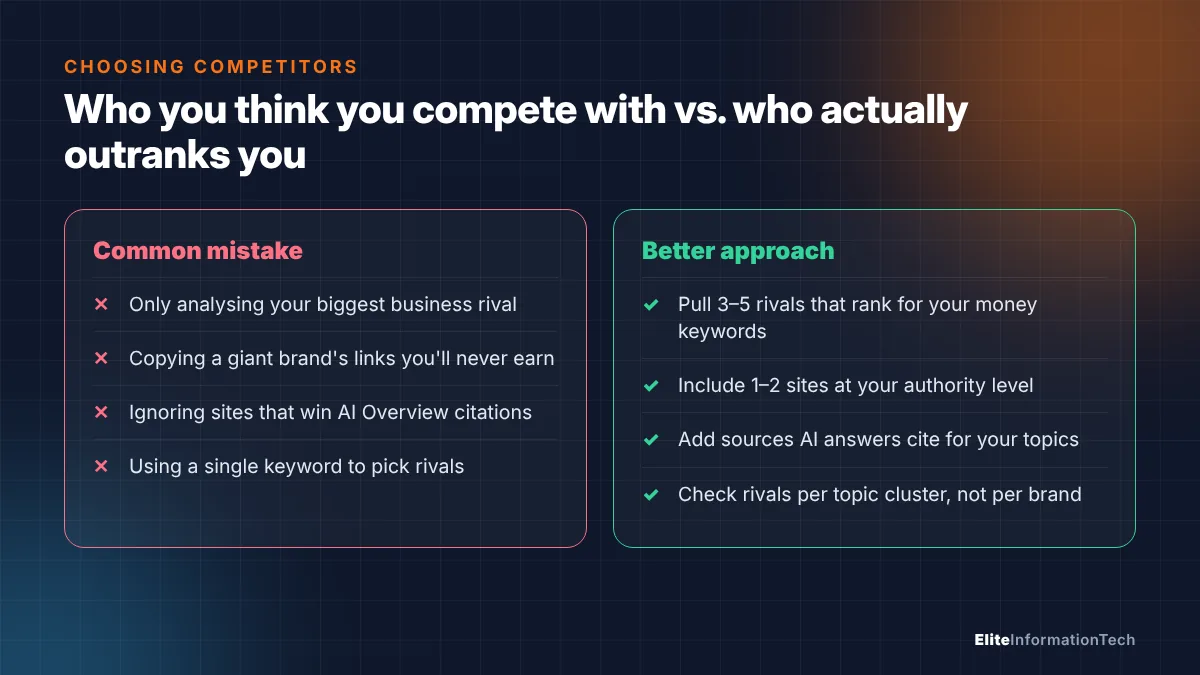
If you sell several services, your competitors change by topic. The site beating you for "Shopify SEO" is probably not the one beating you for "local SEO for dentists". Run the analysis per topic cluster and your lists get sharper and far more relevant.
Aim for 3–5 competitors per cluster. More than that and the data gets noisy; fewer and you miss patterns.
Step 2: Pull their referring domains (not just backlinks)
A backlink is a single link. A referring domain is a unique website that links to you. If a forum links to your competitor 3,000 times from user signatures, that's 3,000 backlinks and one referring domain of questionable value. Always work with referring domains first.
Competitor backlink analysis is the process of reviewing which websites link to your competitors, how those links were earned, and which of them you could realistically earn too. Referring domains are where it starts. Here's how to pull them in the main tools:
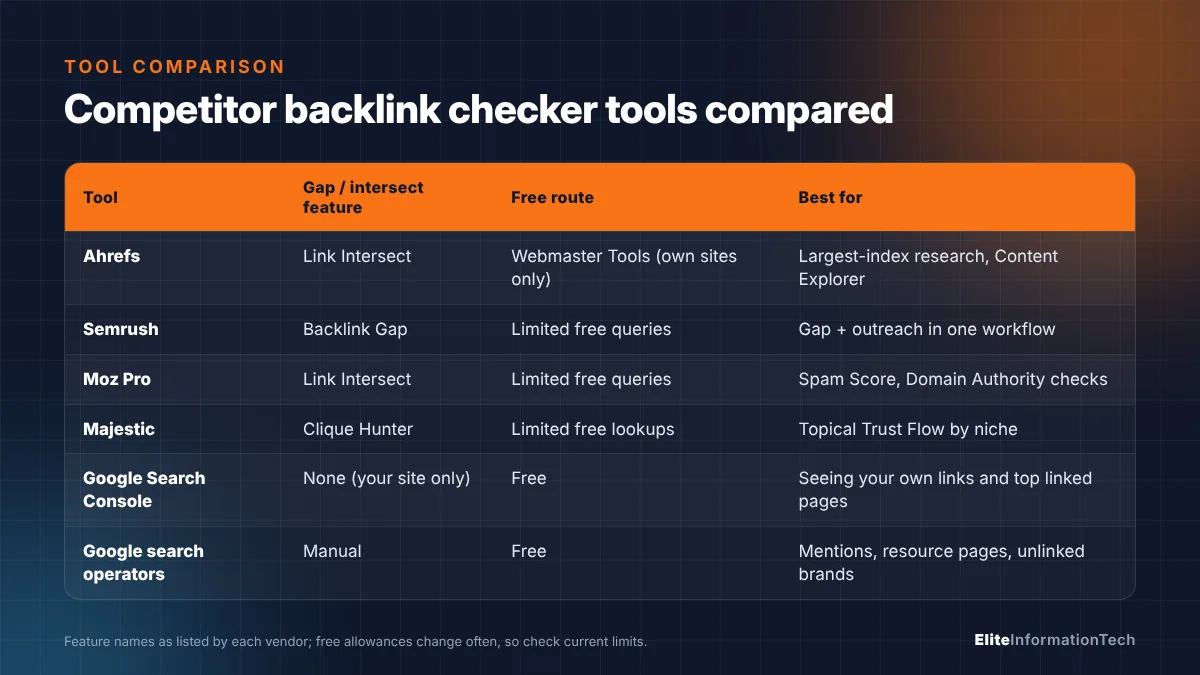
- Ahrefs: Site Explorer → enter the competitor's domain → Referring domains. Filter to "Dofollow", set a minimum Domain Rating if the list is huge, and add a minimum traffic filter to strip out dead sites.
- Semrush: Backlink Analytics → enter the domain → Referring Domains tab. Filter by Authority Score and category.
- Moz: Link Explorer → Linking Domains. Moz's Spam Score column helps you spot junk quickly.
- SE Ranking and Ubersuggest: both have backlink and competitor reports at lower price points, which suit small sites and freelancers.
- Majestic: Site Explorer → Ref Domains. Its Topical Trust Flow shows which niches a linking site belongs to, which is handy for relevance checks.
Which filters actually matter? Most people filter by Domain Rating or Domain Authority and stop. That's half the job. Third-party authority scores are estimates; a DR 70 site with no organic traffic is often a link seller in disguise. Add these filters instead:
- Organic traffic > a few hundred visits/month: proof Google still trusts the site.
- "First seen" in the last 12–24 months: shows who's actively linking right now.
- Language and country: a Brazilian blog linking to a US competitor is rarely replicable for an Indian SaaS.
- Dofollow first, nofollow second: but don't throw nofollow away. Editorial nofollow mentions from big publications still send traffic, build brand searches and feed AI systems.
Export each competitor's list to a spreadsheet. You'll need it in the next step.
Step 3: Run a backlink gap (link intersect) analysis
This is where competitor research turns into a lead list.
A backlink gap analysis compares several domains at once and shows you sites that link to your competitors but not to you. Ahrefs calls it Link Intersect (now inside its Competitive Analysis tool), Semrush calls it Backlink Gap, and Moz calls it Link Intersect too.
How to run it:
- Enter your 3–5 competitors as the "targets" and your own domain as the site you want to exclude.
- Set the tool to show domains linking to at least two of the competitors.
- Sort by the number of competitors linked. Sites linking to 3 of 3 competitors go straight to the top.
Why "at least two"? One link to one competitor could be a fluke: a friend's blog, a paid placement, an old partnership. When a site links to several companies in your space, it's telling you something: "We cover this topic, and we link to providers in it." You're not a stranger asking a favour. You're the obvious missing name.
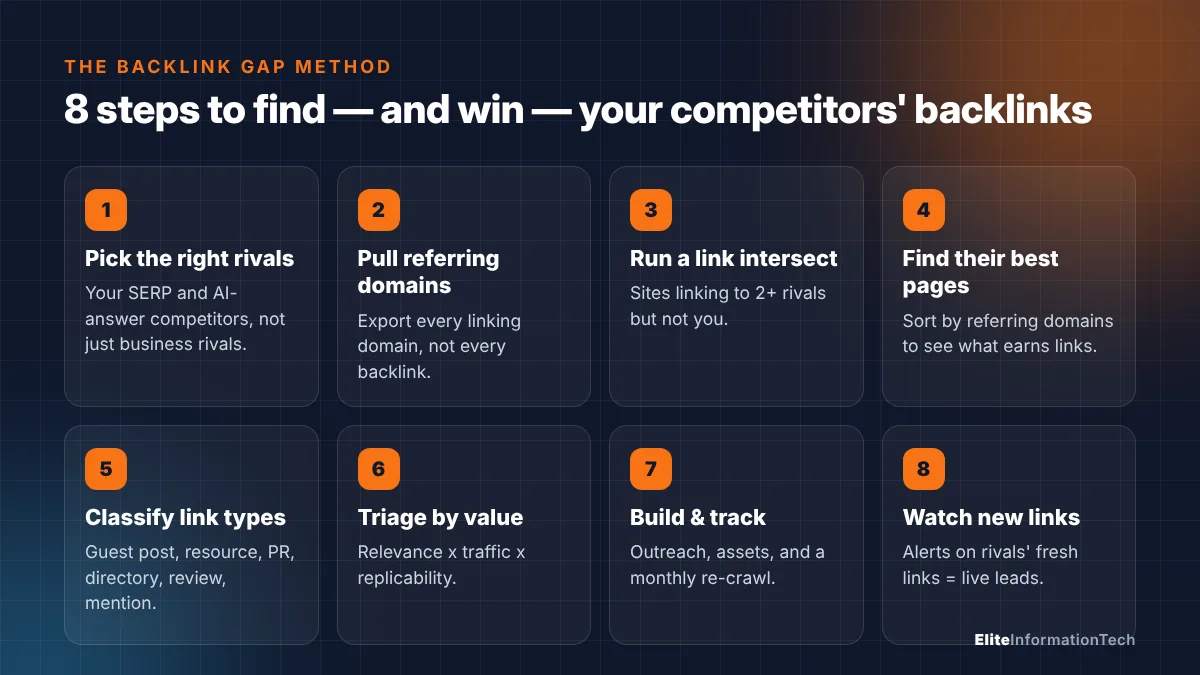
Say you run an HR software company in Bengaluru and compare yourself with three rivals. Your link intersect might surface a "Best HR tools for startups" list on a well-read founder blog, a university career-services resource page, and a payroll compliance guide on an accounting firm's site. Each links to two or three of your rivals. That's three warm, relevant pitches — found in about ten minutes.
Step 4: Find the pages that earn their links
Most people stop at "who links to my competitor". The smarter question is "what are they linking to?"
In Ahrefs, open Best by links. In Semrush, use Indexed Pages inside Backlink Analytics and sort by referring domains. You'll usually see a pattern within seconds: a small number of pages earn most of a site's links.
Those pages are linkable assets, and they tend to fall into a few types:
| Asset type | Why it earns links | Your move |
|---|---|---|
| Original data / surveys | Writers need stats to cite | Run a smaller, fresher, more local study |
| Free tools & calculators | Resource pages love useful tools | Build a simpler or more niche version |
| Definitive guides / glossaries | Easy reference for "learn more" links | Make it clearer, more visual, more current |
| Templates & checklists | Practical and shareable | Offer a better format (Sheets, Notion, PDF) |
| Homepage | Brand mentions, listicles, PR | Get into the same "best X" lists and roundups |
If a competitor's "2026 salary benchmark report" has links from 180 domains, you don't need to guess what your industry wants. Build a better 2027 version, then pitch it to the same 180 sites. (This is the "skyscraper" idea — but it only works when your version is clearly better: newer data, better design, or a sharper angle. A slightly longer copy isn't enough.)
Step 5: Classify every link by type
Now go back to your backlink gap list and tag each site with how the link was earned. It sounds tedious. It's the step that saves you the most time later, because each type has a completely different playbook.
| Link type | How to spot it | Difficulty to replicate |
|---|---|---|
| Guest post | Author bio with a link, "guest author" byline | Medium |
| Resource / links page | "Useful resources", "tools we recommend" | Easy–medium |
| Listicle / roundup | "Best X tools for Y" articles | Medium |
| Digital PR / news | News sites quoting data or an expert | Hard |
| Podcast / interview | Show notes linking to the guest's site | Easy–medium |
| Directory / citation | Business listings, association member pages | Easy |
| Integration / partner | "Works with", partner directories | Depends on your product |
| Paid / sponsored | "Sponsored" label, rel="sponsored" | Easy, but see the warning below |
If a competitor's profile is full of low-quality guest posts with exact-match anchors, they may be ranking despite those links, not because of them. Google's spam policies explicitly list "links with optimized anchor text in articles, guest posts, or press releases distributed on other sites" and "buying or selling links for ranking purposes" as link spam. Copy the strategy behind good links. Never copy the shortcuts.
Step 6: Triage and decide what's worth your time
You might now have 400 prospects. You won't pitch all of them, and you shouldn't. Give each one a quick score from 0–3 on three questions:
- Relevance: Would this site's readers genuinely care about your business?
- Value: Does it get real organic traffic, and would a link here send visitors or credibility?
- Replicability: Can you realistically earn this link in the next 90 days?
Anything scoring 7 or more goes into this month's work. 4–6 goes into a backlog. Under 4, delete it and don't look back.
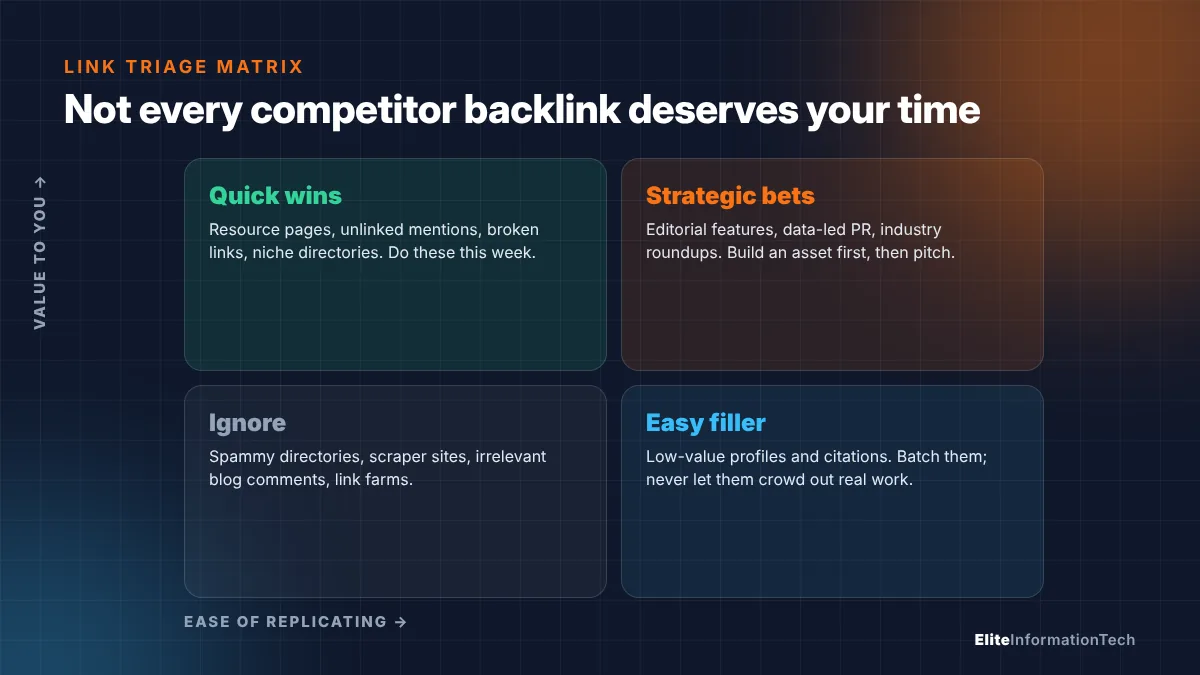
Over a few campaigns you'll notice the quick wins and strategic bets usually end up being a small slice of the original list. That's expected. Ten relevant links beat a hundred random ones, for Google and for AI search.
Step 7: Win the links with a playbook for each type
Here's how to turn each category on your list into actual links.
Resource pages: the fastest wins
If a page lists "best tools for X" and includes your competitors, your pitch is simple: here's another option your readers might find useful, and here's exactly why. Point to one specific feature or resource that isn't already on the list. Keep it under 100 words.
Unlinked brand mentions: links you already earned
Search Google for your brand name excluding your own site ("Your Brand" -site:yourdomain.com), or set up mention alerts in Ahrefs or Semrush. When someone mentions you without linking, a friendly note asking them to add the link has a far better hit rate than cold outreach. And even if they don't add it, the mention still helps; remember that web mentions were the factor most tied to AI Overview visibility.
Broken links on competitor-linking pages
In Ahrefs, check your competitors' Broken backlinks report, or run the linking pages through a broken link checker. When a site links to a dead competitor page, offer your live equivalent. You're fixing their problem first, which is why this tactic still works in 2027.
Guest posts on sites that already host your competitors
If a rival has a guest post on a respected industry blog, that blog accepts contributors and covers your topic. Pitch a different angle, never the same one. We break down this process in our guide on how to find guest posting sites in your niche.
Roundups, listicles and "best X" lists
These matter more than ever, because AI tools often draw on them when recommending products. Contact the author with a short, honest case for inclusion: who you're best for, one proof point, and a free account or demo if relevant.
Digital PR and expert quotes
If competitors earn news links, look at what the coverage cites. Usually it's data or a sharp expert opinion. Journalist-request platforms such as Qwoted and Featured are worth monitoring, and publishing small original studies gives journalists a reason to cite you instead.
Whatever the type, the email you send decides whether any of this works. Read our breakdown of link building outreach that actually gets replies before you hit send. The data on follow-ups and personalisation alone will change your results.
Step 8: Watch their new links every month
A competitor's new backlinks are the warmest leads in SEO. If a journalist linked to your rival last week, that journalist is writing about your topic right now.
- Set up new backlink alerts for each competitor (Ahrefs Alerts, Semrush and Moz all offer variations).
- Check their lost backlinks too. A lost link can mean a page that just got updated and is open to a replacement source.
- Re-run your link intersect once a month. It takes 15 minutes once your filters are saved.
- Track your own referring domains next to theirs so you can see whether the gap is closing.
How to check competitor backlinks for free
No budget for a paid tool yet? You can still get surprisingly far:
- Ahrefs' free backlink checker shows a competitor's top 100 backlinks, top pages and anchors.
- Ahrefs Webmaster Tools is free for sites you own, so you can see your own full profile for comparison.
- Semrush and Moz free accounts give limited lookups (daily on Semrush, around 10 queries a month on Moz), enough for a quick look at a small competitor set.
- Google Search Console (Links report) shows your top linking sites and most-linked pages.
- Google search operators find mentions and resource pages:
"competitor name" -site:competitor.com,intitle:resources "your topic","competitor name" "best" tools.
| Free option | What you get | Main limit |
|---|---|---|
| Ahrefs free backlink checker | Top 100 backlinks, top pages, top anchors for any domain | No full export or filters |
| Ahrefs Webmaster Tools | Full backlink data | Only for sites you've verified you own |
| Semrush free account | Backlink overview and limited reports | Small daily request limit |
| Moz free account | Link Explorer queries | Around 10 queries per month |
| Google Search Console | Your own top linking sites and pages | Cannot show competitors' links |
| Google search operators | Mentions, resource pages, roundups | Manual and incomplete |
Free tools show you a slice of the picture, not the whole thing. For a one-off analysis that's fine. For ongoing monitoring across several competitors, a paid tool usually pays for itself in hours saved.
Beyond the list: anchor text, link velocity and toxic links
Once you have the gap list, three more checks round out a proper competitor backlink audit.
Anchor text distribution
Look at the anchor text report for each competitor. Healthy profiles are dominated by brand names, URLs and generic phrases ("this guide", "here"). If a competitor ranks with a high share of exact-match commercial anchors, treat that as a risk they're carrying rather than a model to copy.
Link velocity
Link velocity is how quickly a site gains new referring domains. Compare the referring domains chart for you and each rival over the last 12 months. If a competitor gains 20 new referring domains a month and you gain 3, that tells you how much effort closing the gap really needs. A sudden spike is worth a closer look: it's often a viral asset, a PR hit, or a batch of bought links.
Toxic or spammy links
Every site picks up some junk links over time. Google says it generally ignores most of them, so don't panic about a competitor's spam or your own. Just make sure none of those spammy domains end up on your outreach list. Moz's Spam Score and a quick manual look at traffic and content are usually enough to filter them out.
How many backlinks do you need to outrank a competitor?
There's no fixed number. A better rule of thumb: compare the referring domains to the specific pages ranking in the top five for your keyword, not their whole domain. If the top results each have links from 15–40 relevant domains and your page has 2, you know roughly what you're aiming for. Relevance and quality still matter more than the raw count.
The 2027 twist: optimising for AI search, not just Google
Competitor backlink analysis used to be purely about rankings. In 2027 it's also about Generative Engine Optimisation (GEO): getting your brand mentioned and cited in AI-generated answers.
Three things change when you look at competitor links with AI search in mind:
- Mentions count, even without links. Track where competitors are named, not just linked. Reviews, comparisons, forum threads and expert roundups all shape how AI tools describe a category.
- Source type matters. AI tools lean on a mix of reference sites, forums, review platforms and trusted publications. 5W's 2026 synthesis of AI citation research found Reddit was the most-cited domain across platforms in one 30-million-citation dataset. If your competitors are discussed there and you're not, that's a gap — just not one you fill with spam.
- Consistency builds entity trust. When the same brand name, description and category appear on many independent sites, AI systems have an easier time understanding who you are. Use your competitor research to find where your brand should be listed and described consistently.
Our AI search optimisation (GEO) service uses exactly this kind of competitor citation mapping to find where a brand is missing from AI answers.
Competitor backlink mistakes that waste months
- Chasing Domain Rating alone. DR and DA are third-party estimates. Relevance and real traffic matter more.
- Copying every link. Some of your competitor's links are spam that hasn't caught up with them yet.
- Buying links that pass ranking credit. Google's guidance is clear: paid links should be marked rel="sponsored" or rel="nofollow". Unmarked ones risk penalties.
- Ignoring anchor text. If you replicate links, keep anchors natural: mostly brand and URL, with only some topical anchors.
- Doing it once. A backlink gap is a moving target. Monthly checks beat a single giant audit.
- Analysing only the homepage. Most links go to specific pages. Analyse at page level to find the asset ideas.
Your competitor backlink checklist for 2027
- List 3–5 competitors per topic cluster: search, peer and AI-answer competitors.
- Export referring domains with traffic, recency and language filters.
- Run a link intersect for sites linking to 2+ competitors but not you.
- Find competitors' most-linked pages and note the asset types.
- Tag each prospect by link type.
- Score relevance, value and replicability; work the 7+ list first.
- Use the right playbook for each link type.
- Set up alerts for competitors' new and lost links.
- Track brand mentions as well as links for AI search visibility.