Key takeaways
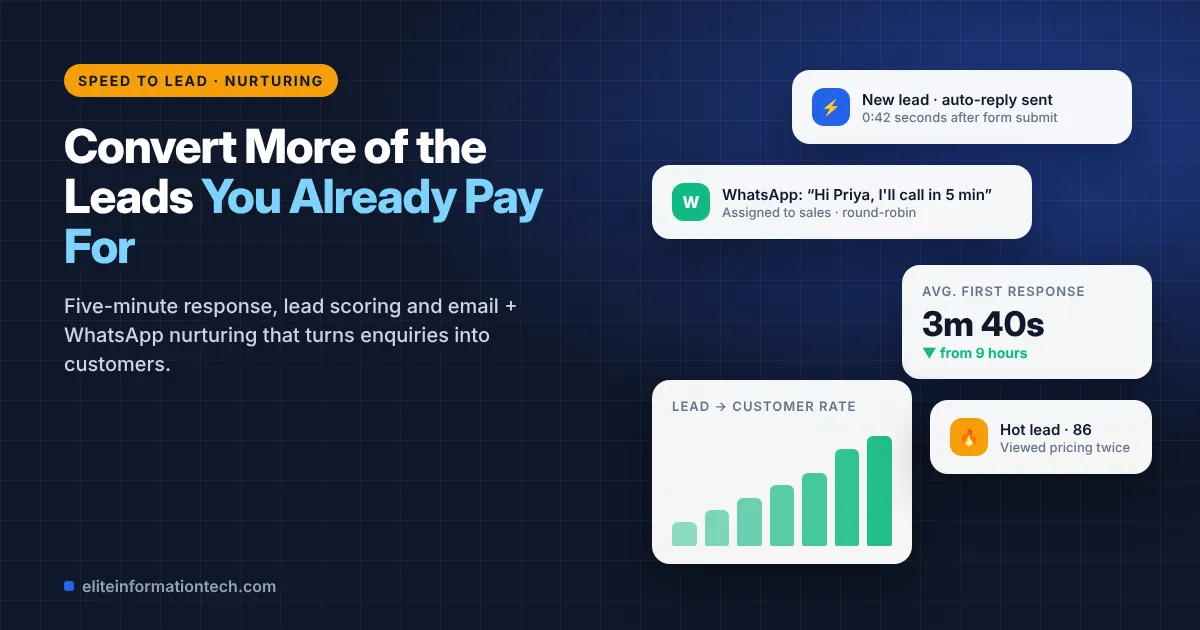
- Responding within five minutes dramatically increases contact and qualification rates.
- Use automation for speed and humans for conversation.
- Lead scoring focuses sales on the leads most likely to buy.
- Nurture across email, WhatsApp, SMS and retargeting, not just email.
- Measure lead-to-customer rate by source, then feed it back into your ads.
Most businesses try to fix weak sales by buying more leads. They increase ad budgets, add new channels and push for more form fills. Yet the biggest opportunity is usually sitting inside their CRM already: the leads they paid for and never properly followed up.
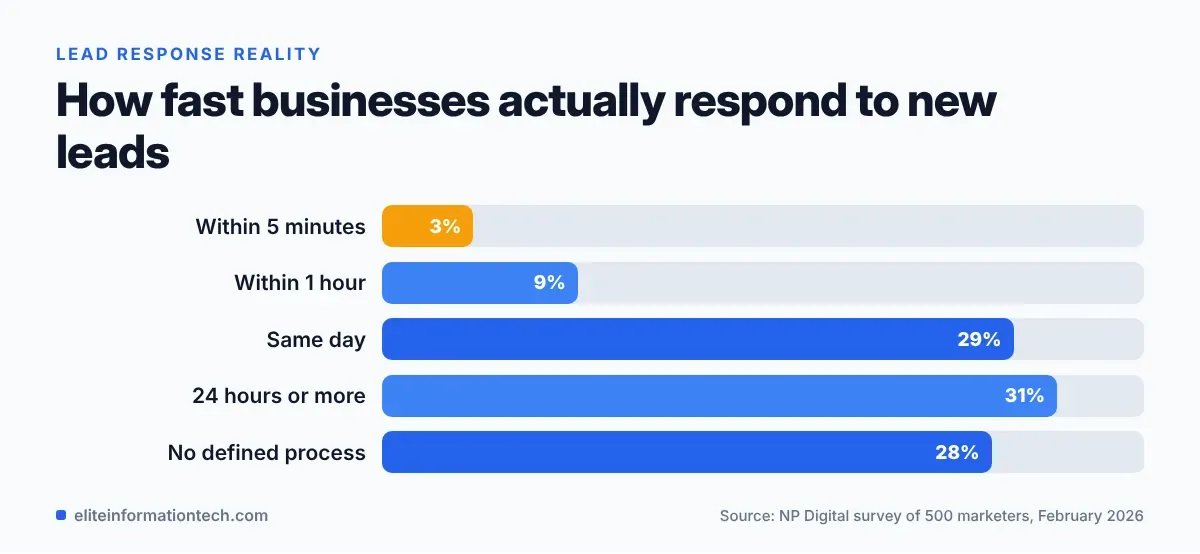
The numbers are stark. Research cited by G2, originally from Salesforce and MarketingSherpa, suggests that around 79% of marketing leads never convert into sales, largely because of poor nurturing. An NP Digital survey of 500 marketers found only 3% respond to new leads within five minutes, while 31% take a day or longer and 28% have no defined follow-up process at all.
So here is the opportunity. If your competitors are slow and inconsistent, being fast and helpful is one of the most powerful competitive advantages you can build. This guide shows you how to set up speed to lead, lead scoring and multi-channel lead nurturing so more of your existing leads become customers.
What Is Speed to Lead?
Speed to lead, also called lead response time, is the time between a prospect showing interest and your business making meaningful contact. That interest might be a form fill, a missed call, a WhatsApp message, a demo request or a chat.
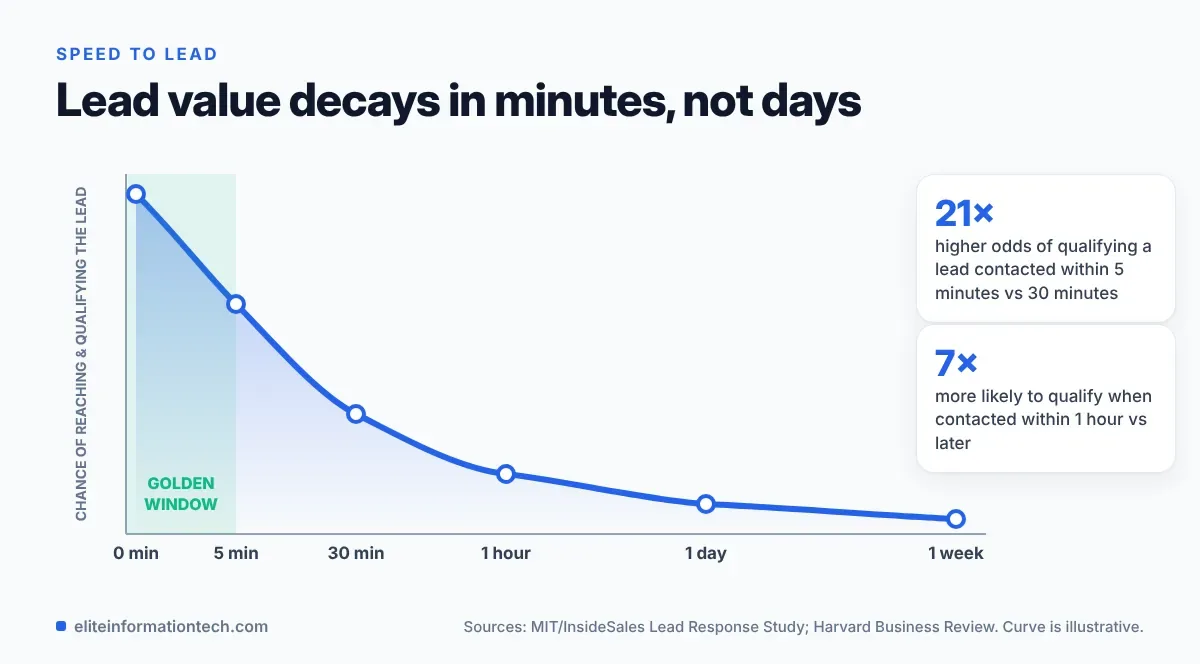
The concept became famous through the Lead Response Management study by Dr James Oldroyd with MIT and InsideSales, which found that the odds of contacting a lead are dramatically higher when you call within five minutes compared with 30 minutes, and the odds of qualifying the lead are around 21 times higher. A Harvard Business Review analysis of more than a million leads found that companies contacting leads within an hour were around seven times more likely to qualify them than companies waiting even slightly longer.
Why does speed matter so much?
- Intent is highest at the moment of enquiry. The buyer is thinking about the problem right now.
- Buyers contact several providers. The first business to respond helpfully often frames the whole decision.
- Memory fades fast. A few hours later, many leads cannot remember which company they contacted.
- Speed signals quality. A fast response suggests a well-run business that will treat customers well.
How Fast Are Businesses Really Responding?
Independent tests keep reaching the same conclusion. Workato submitted demo requests to 114 B2B companies and found that the vast majority failed to respond within five minutes. Chili Piper's research found more than 80% of companies took longer than five minutes or did not respond at all.
This is good news for you. In most markets, the bar is low. A business that replies in minutes, every time, stands out immediately.
Step 1: Build a Speed-to-Lead System
Speed cannot depend on someone happening to check their inbox. It needs to be designed into your process.
Instant acknowledgement (0–60 seconds)
The moment a lead arrives, send an automatic, personal-sounding confirmation:
- Email: confirm what they asked for, what happens next, and who will contact them.
- WhatsApp or SMS: a short message from a named person, with a booking link.
- Thank-you page: a calendar to book a call immediately, plus a short video or case study.
Example WhatsApp message:
Hi Priya, thanks for requesting a quote for office interiors. I’m Aman from the projects team. I'll call you in the next few minutes. If now isn't a good time, you can pick a slot here: [booking link].
Instant routing (0–2 minutes)
Route each lead to the right person automatically based on service, location, deal size or language. Use round-robin assignment so leads are shared fairly, and send real-time alerts through the CRM app, WhatsApp, SMS or Slack.
Human contact (2–5 minutes)
A real person calls or messages within five minutes during business hours. The first call should be helpful, not pushy: confirm the need, ask two or three qualifying questions, and agree on a clear next step.
After-hours coverage
Leads do not stop at 6 pm. Use automated booking so after-hours leads can schedule a call for the next morning, and consider a chatbot or AI assistant that answers basic questions and books appointments.
Persistence rules
Many leads are not reached on the first attempt. Define a follow-up cadence, for example:
- Day 0: call within 5 minutes, then WhatsApp and email if no answer.
- Day 0: second call attempt 2–3 hours later.
- Day 1: call plus a short personal email.
- Day 2: WhatsApp with a helpful resource.
- Day 4: call and voicemail.
- Day 7: "Should I close your file?" email.
Where AI assistants help (and where they don't)
AI chat and voice assistants can now answer common questions, qualify basic details and book appointments around the clock. Used well, they close the after-hours gap and make sure no enquiry waits until morning. Use them to:
- Acknowledge every lead instantly in a natural, conversational tone.
- Collect qualifying details such as service needed, location, budget and timeline.
- Book meetings directly into your team's calendars.
- Answer factual questions about services, pricing ranges and process.
Keep humans in charge of anything that requires judgement, negotiation or empathy, and always make it easy for a lead to reach a real person. The goal is speed without losing the personal touch that wins the deal.
Step 2: Score Leads So Sales Focuses on the Right Ones
Not every lead deserves the same effort. Lead scoring ranks leads by how likely they are to become customers.
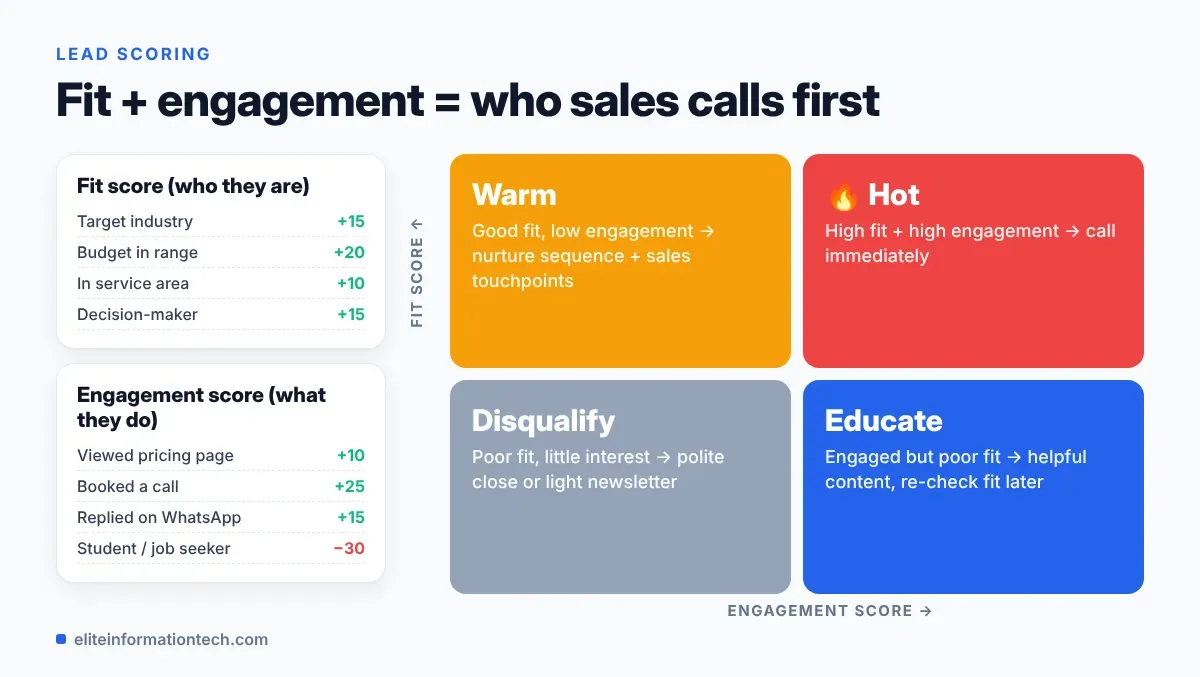
Fit score (who they are)
Assign points for characteristics that match your best customers:
- Industry or business type.
- Company size, budget range or project size.
- Location within your service area.
- Job title or decision-making role.
- Source channel with a history of high close rates.
Engagement score (what they do)
Add points for behaviour that signals buying intent:
- Visited pricing, case study or comparison pages.
- Opened and clicked recent emails.
- Replied to a WhatsApp message.
- Booked a call or attended a webinar.
- Returned to the website multiple times in a week.
Subtract points for negative signals: student email domains, job-seeker behaviour, unsubscribes or long inactivity.
Turn scores into actions
- Hot leads: high fit and high engagement. Sales calls immediately.
- Warm leads: good fit, low engagement. Enter a nurture sequence with regular sales touchpoints.
- Cold leads: low fit. Light-touch educational nurture, or politely disqualify.
Review your scoring model every quarter by comparing scores with actual closed deals. If high-scoring leads are not closing, adjust the weights.
Step 3: Design Lead Nurturing Sequences That Help, Not Hassle
Lead nurturing is the process of building a relationship with leads who are not yet ready to buy, so that when they are ready, you are the obvious choice.
Principles of effective nurturing
- Be useful first. Every message should teach, clarify or solve something.
- Segment by need and stage. A lead interested in SEO should not receive messages about web design.
- Use multiple channels. Combine email, WhatsApp, SMS, retargeting ads and occasional calls.
- Keep messages short and personal. Plain-text emails from a real person often outperform designed newsletters.
- Always include a clear next step. Book a call, see a case study, get a quote.
A 21-day nurture sequence for service businesses
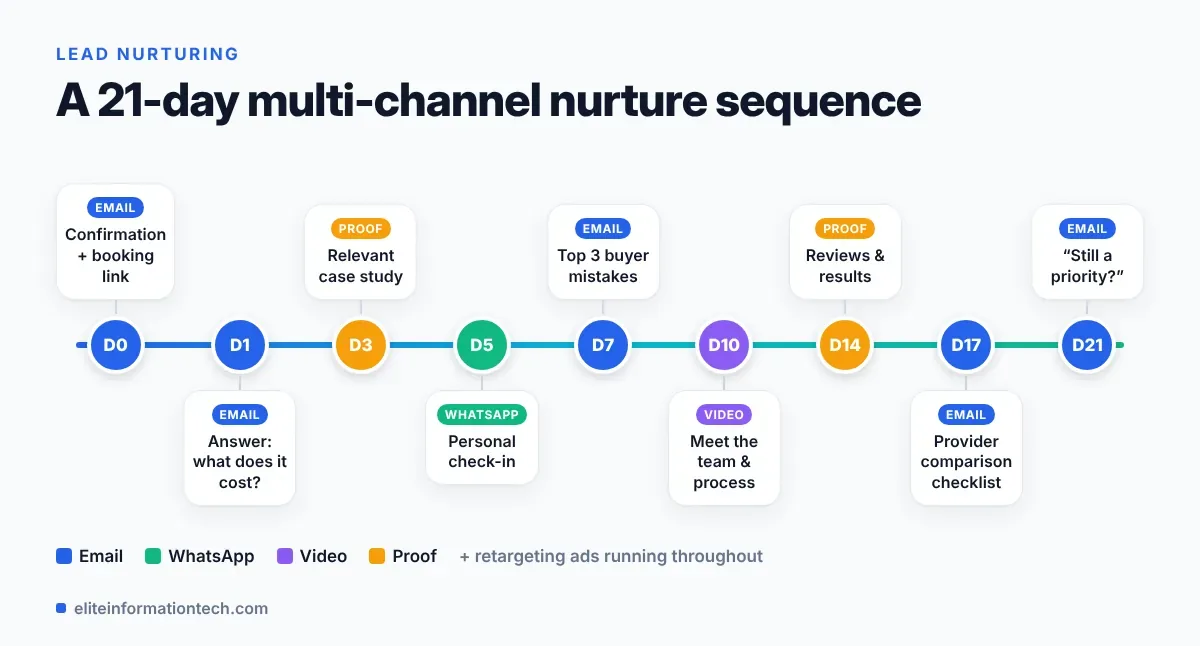
- Day 0: Confirmation email and WhatsApp. Booking link.
- Day 1: Email answering the most common question in your industry, such as "How much does it cost?".
- Day 3: Case study relevant to their industry or problem.
- Day 5: WhatsApp check-in from their assigned contact.
- Day 7: Email covering the top three mistakes buyers make, and how to avoid them.
- Day 10: Short video introducing your team and process.
- Day 14: Social proof: reviews, ratings and results.
- Day 17: Comparison or checklist to help them evaluate providers.
- Day 21: A friendly, direct email: "Is this still a priority for you?"
After 21 days, unresponsive leads move into a monthly newsletter and periodic retargeting until they re-engage.
B2B nurturing: longer cycles, more stakeholders
B2B buyers often involve several decision-makers and take months to decide. Extend sequences over 60–90 days and include content for different roles: ROI and pricing for finance, implementation details for operations, and strategic outcomes for leadership. Account-based retargeting on LinkedIn helps keep the whole buying group engaged.
WhatsApp lead nurturing best practices
In India, the Middle East, Latin America and much of Europe, WhatsApp is often where conversations actually happen. Use the WhatsApp Business Platform with:
- Clear opt-in at the point of enquiry.
- Approved message templates for first contact.
- Short, conversational messages from a named person.
- Quick replies and catalogue links for common requests.
- CRM integration so every conversation is logged.
Respect frequency. WhatsApp is personal; over-messaging leads to blocks and reports.
Step 4: Connect Your CRM, Ads and Analytics
Nurturing becomes far more powerful when your systems talk to each other.
Essential integrations
- Website forms, calls and WhatsApp to CRM: every lead captured automatically with source data such as UTM parameters, GCLID and landing page.
- CRM to email and WhatsApp automation: sequences triggered by lead status and score.
- CRM to ad platforms: qualified leads and closed deals sent back to Google Ads and Meta so bidding optimises for real outcomes. We explain this in our Google Ads lead generation guide.
- CRM to analytics: revenue attributed to channels, campaigns and content.
Lead statuses that keep everyone aligned
Use a simple, shared lifecycle: New → Contacted → Qualified → Meeting / Quote → Won or Lost (with a reason). Lost reasons such as "price", "timing", "chose competitor" or "not a fit" are gold for improving marketing and offers.
Our email, CRM and social team sets up these workflows on platforms like HubSpot, Zoho and other CRMs.
Lead Nurturing Email Templates You Can Adapt
Good nurture emails are short, personal and useful. Here are three templates you can adapt for your business.
Template 1: The day-one answer email
Subject: The honest answer to "how much does it cost?"
Hi {first name},
Most people who contact us ask the same first question: what will this cost? The honest answer is that it depends on three things: {factor 1}, {factor 2} and {factor 3}.
To give you a sense of scale, most of our {service} projects for businesses like yours fall between {range}. I've put a short breakdown here: {link}.
If you'd like an exact figure for your situation, you can grab 15 minutes with me here: {booking link}.
{Name}, {Role}
Template 2: The relevant case study
Subject: How {similar company} solved {specific problem}
Hi {first name},
You mentioned {their challenge}. We worked with {similar company or industry} on almost the same issue last year.
In short: they were {situation}, we {what you did}, and within {timeframe} they {result}.
The full story is here if it's useful: {link}. Happy to walk you through how it might apply to you.
Template 3: The polite break-up
Subject: Should I close your file?
Hi {first name},
I haven't heard back, which usually means one of three things: the timing isn't right, you've found another solution, or you've been buried in work.
Any of those is completely fine. Just reply with a number so I know where things stand:
1 – Still interested, let's talk this week 2 – Interested, but later in the year 3 – Not a priority anymore
Thanks either way, {Name}
The break-up email often gets the highest reply rate in the sequence because it is easy to answer and respects the buyer's time.
Common Lead Nurturing Mistakes
- Sending the same newsletter to everyone. Generic messages get ignored; segmented messages get replies.
- Selling in every message. If every email says "book a call", leads stop opening them.
- Stopping after one or two attempts. Many leads need several touches before they reply.
- Over-messaging on WhatsApp. Daily messages feel like spam and lead to blocks.
- No handover rules. Marketing nurtures a lead that sales is already talking to, or vice versa, and the buyer receives conflicting messages.
- Never cleaning the list. Unengaged contacts hurt email deliverability. Remove or suppress leads who have not engaged in six to twelve months.
- Measuring opens instead of outcomes. The goal is booked calls and revenue, not open rates.
Step 5: Re-Engage Old and Lost Leads
Your CRM probably contains hundreds or thousands of old leads that never converted. Some were not ready. Some chose a competitor who disappointed them. Some simply forgot.
Run a re-engagement campaign every quarter:
- A short, personal email: "Are you still looking for help with X?"
- A new offer: free audit, updated pricing, seasonal promotion.
- A fresh case study or result.
- A WhatsApp or SMS follow-up for leads who opted in.
- A retargeting audience built from your old lead list.
Re-engagement campaigns are among the cheapest lead generation activities available, because you already paid to acquire these contacts.
Step 6: Measure What Matters
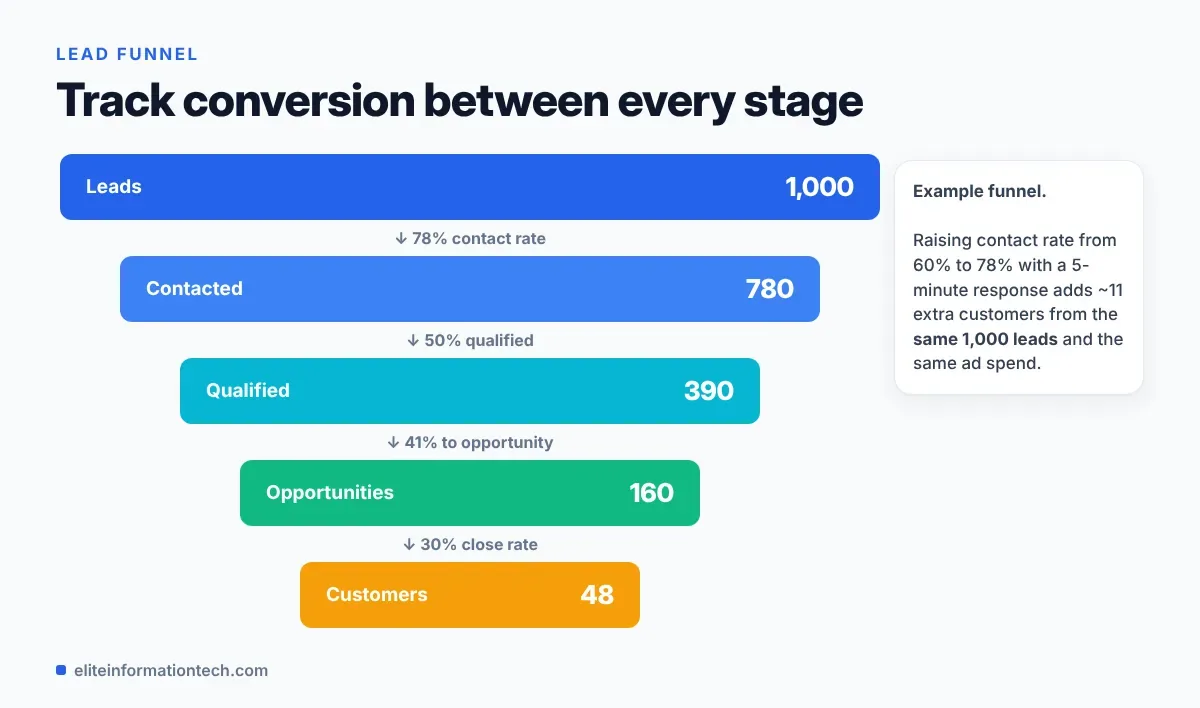
Track these metrics monthly, by lead source:
| Metric | What it tells you | Healthy direction |
|---|---|---|
| Average first response time | How fast you engage | Under 5 minutes in business hours |
| Contact rate | Share of leads you actually reach | Rising |
| Lead-to-qualified rate | Lead quality and qualification process | Rising |
| Qualified-to-customer rate | Sales effectiveness and fit | Rising |
| Nurture engagement | Opens, clicks and replies by sequence | Stable or rising |
| Revenue per lead by source | True value of each channel | Rising |
When you know revenue per lead by source, budget decisions become simple. Spend more where leads turn into revenue, and fix or cut the rest.
A Simple Speed-to-Lead and Nurture Setup You Can Build This Month
- Week 1: Map every way leads reach you. Connect them all to one CRM. Turn on instant email and WhatsApp confirmations.
- Week 2: Set up routing and real-time alerts. Agree a five-minute response rule and a seven-day follow-up cadence with your team.
- Week 3: Build a basic fit and engagement score. Write your first 21-day nurture sequence.
- Week 4: Connect qualified-lead data back to Google Ads and Meta. Launch a re-engagement campaign for old leads.
Then review response times and conversion rates weekly. Small improvements compound quickly.
How Nurturing Fits Your Overall Lead Generation Strategy
Speed to lead and nurturing are the final stages of a complete lead generation system. Visibility in Google, AI search and maps brings buyers in; landing pages convert them; fast follow-up and nurturing turn them into customers. If you are building the full system, start with our overview of lead generation strategies for 2027, then improve conversion with our guide to lead generation landing pages.