Key takeaways
- Your Google Business Profile is your most valuable free lead source; treat it like a website.
- Reviews are now a gate: buyers want many recent, detailed reviews and owner replies.
- AI assistants recommend local businesses, so consistent citations and mentions matter.
- Strong location and service pages support both Map Pack and organic rankings.
- Track calls, direction requests and WhatsApp messages, not just website forms.
When a pipe bursts, a tooth cracks or a client needs a lawyer by Friday, people do not browse. They search, compare two or three options, and call. BrightLocal's 2026 research found that 75% of consumers decide which local business to use in under 30 minutes, and 72% look at three or fewer businesses before choosing.
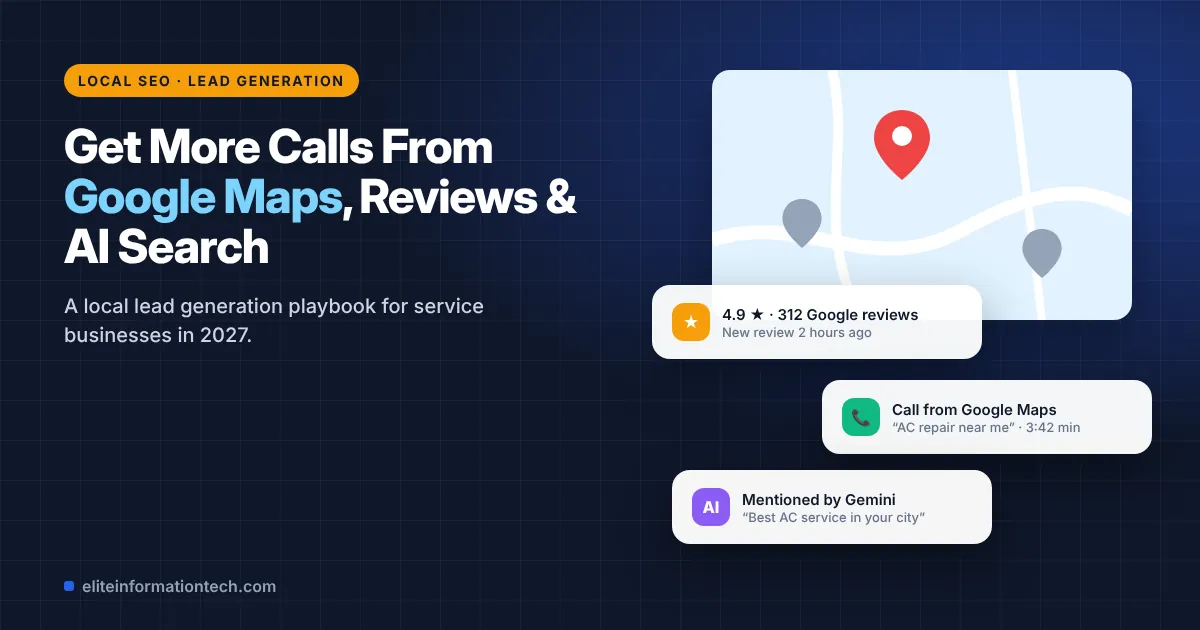
That makes local lead generation a race for a very small shortlist. If you are in the Google Map Pack, mentioned by AI assistants, and backed by strong recent reviews, you get the call. If you are not, you rarely get a chance.
The local search landscape has also shifted. BrightLocal's Local Consumer Review Survey 2026 shows AI tools have become one of the top sources people use for local recommendations, while Google's share of review-reading has dipped. Buyers now check several platforms before they pick up the phone.
This guide shows plumbers, dentists, clinics, law firms, real estate agents, contractors, salons, schools and every other local service business how to generate a steady stream of local leads in 2027.
How Local Buyers Find Service Businesses in 2027
The local buying journey is shorter than B2B, but it touches more surfaces than ever.
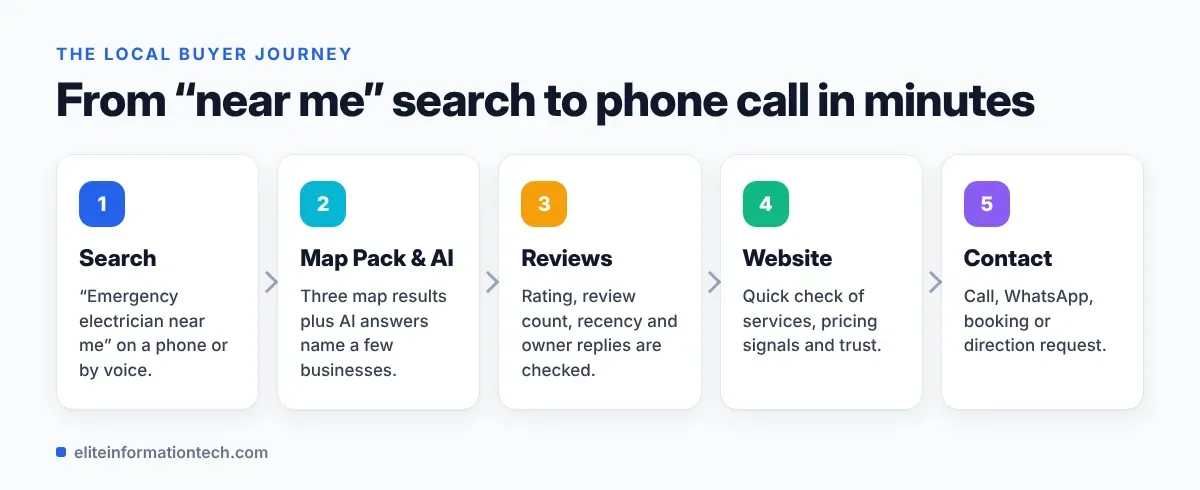
- Search: "emergency electrician near me", "best dermatologist in Jaipur", or a voice query.
- Map Pack and AI answer: Google shows three map results and often an AI Overview; ChatGPT or Gemini may list a few names.
- Reviews and photos: the buyer checks star rating, review count, recency and photos.
- Website check: a quick look at services, pricing signals and trust.
- Contact: a call, a WhatsApp message, a booking or a direction request.
BrightLocal reports that 73% of local searches start on a mobile device, and close to half of consumers often add "near me" to local queries. Your local lead generation strategy needs to work on a phone, in seconds.
Step 1: Turn Your Google Business Profile Into a Lead Machine
For most local businesses, the Google Business Profile (GBP) produces more leads than the website itself. Calls, direction requests and website clicks from GBP are some of the highest-intent actions online.
Get the fundamentals exactly right
- Primary category: choose the most specific category that describes your main service. This is one of the strongest Map Pack ranking factors.
- Secondary categories: add every relevant service category, but avoid unrelated ones.
- Business name: use your real business name. Keyword stuffing risks suspension.
- Address or service area: accurate and consistent with your website and listings.
- Hours: including holiday hours. Being shown as open matters for "open now" searches.
- Phone number: a local number, tracked with a call-tracking number set as primary and your main line as additional.
Fill out services, products and attributes
Add every service with a short description and, where possible, a starting price. Use attributes such as "online appointments", "wheelchair accessible", "women-owned" or "free estimates". These details help Google match you to more specific searches and help buyers choose you.
Post photos and updates every week
Upload real photos of your team, premises, vehicles and completed work. Use Google Posts for offers, seasonal tips, new services and case highlights. Active profiles signal to both Google and buyers that the business is real and responsive.
Enable messaging and booking
Turn on bookings through a supported scheduling provider and make sure calls and messages are answered fast. A profile that sends people to voicemail wastes the most valuable leads you get.
Step 2: Build a Review Engine, Not a Review Campaign
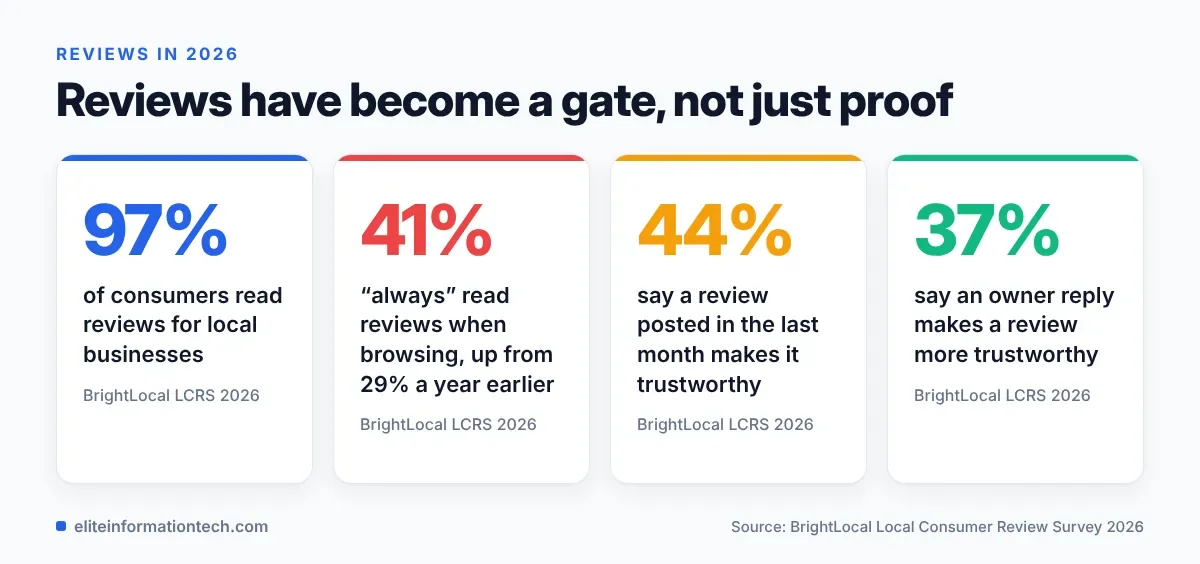
Reviews are no longer just social proof. They are a filter. BrightLocal found that 97% of consumers read reviews for local businesses, and the 2026 survey showed a jump in people who "always" read them. Consumers also told BrightLocal that recency matters: many want to see reviews posted within the last month.
How to get more reviews consistently
- Ask at the moment of delight: right after a job is finished or a problem is solved.
- Make it one tap: send a direct review link by WhatsApp or SMS, plus a QR code at your counter or on invoices.
- Automate the request: trigger a review request from your CRM or booking system after each completed job.
- Train your team: give technicians, receptionists and account managers a simple script.
- Spread across platforms: Google first, then industry sites such as Practo, Justdial, Houzz, Avvo, Yelp or Healthgrades depending on your market.
Respond to every review
Thank positive reviewers by name and mention the service they received. Respond to negative reviews calmly, take the conversation offline and show how you fix problems. Future customers read your replies as carefully as the reviews themselves.
Never buy or gate reviews
Fake reviews and review gating (only asking happy customers) break Google's policies and, in many countries, consumer protection laws. In the United States, the FTC's rule on fake reviews is now being enforced. Real, steady reviews always win in the long run.
Step 3: Rank in the Map Pack
Google's local ranking is based on three broad factors: relevance (how well your profile matches the search), distance (how close you are to the searcher), and prominence (how well known and trusted you are). You cannot change distance, but you can strengthen the other two.
Relevance signals
- Accurate primary and secondary categories.
- Services and descriptions that use the language customers search with.
- A website with dedicated pages for each core service, linked from your GBP.
- Reviews that naturally mention services and locations.
Prominence signals
- Number, rating and recency of reviews.
- Consistent NAP (name, address, phone) citations across trusted directories.
- Local links from chambers of commerce, sponsorships, local news, suppliers and associations.
- Brand searches and mentions across the web.
Our guide to local link building covers prominence in more depth.
Step 4: Build Location and Service Pages That Convert
Your website supports your Map Pack rankings and captures organic traffic for searches where the map does not appear.
Service pages
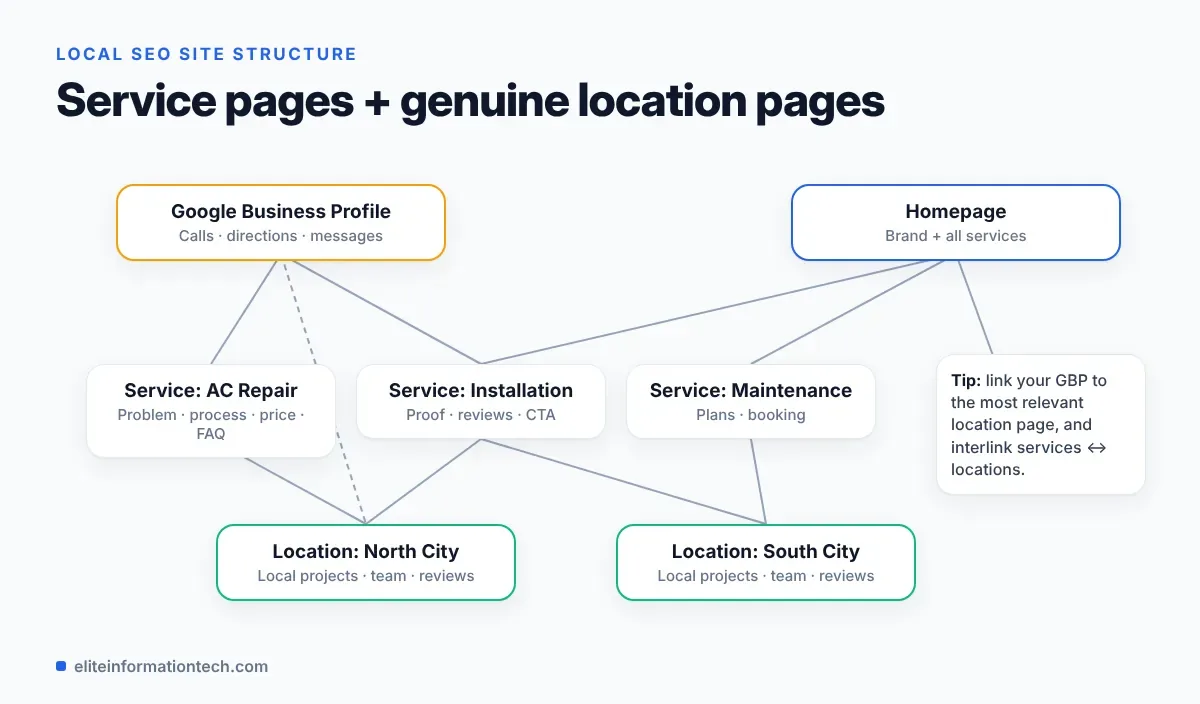
Create one page per core service: "AC repair", "AC installation", "duct cleaning", rather than one generic "Services" page. Each page should explain the problem, your process, pricing guidance, proof and FAQs, with a clear call to action.
Location pages
If you serve several cities or neighbourhoods, create a page for each one you genuinely serve. Make each page unique: local projects, team members based there, local reviews, area-specific information and directions. Thin pages with only the city name swapped are a waste of effort and can harm rankings.
Conversion essentials for local pages
- Click-to-call and WhatsApp buttons visible on mobile.
- Service area and hours stated clearly.
- Reviews and star rating near the top.
- Short quote or booking form.
- Fast loading on mobile networks.
For more conversion tactics, see our guide to lead generation landing pages.
Step 5: Get Recommended by AI Assistants
People now ask ChatGPT, Gemini, Perplexity and Google's AI Mode questions like "Who is the best orthodontist in Pune for adults?" or "Which roofing company in Austin has the best reviews?". The businesses that appear in those answers get a disproportionate share of attention.
BrightLocal's local SEO research cites SOCi data showing that businesses recommended by AI tools tend to have strong average star ratings, around 4.3 stars in ChatGPT recommendations. AI systems lean heavily on reviews, consistent listings and third-party mentions.
To improve local AI search visibility:
- Keep your business details identical across GBP, website, Apple Business Connect, Bing Places, Facebook and major directories.
- Earn mentions in "best of" lists, local news and industry roundups.
- Publish clear, factual pages that answer specific local questions, with your location, services and credentials stated plainly.
- Add LocalBusiness, Service and Review structured data to your site.
- Collect detailed reviews that describe services and outcomes.
Our AI Search team and Google AI Overviews optimisation service specialise in this.
Step 6: Add Paid Local Lead Channels
Organic local visibility compounds over time, but paid channels can fill gaps immediately.
Local Services Ads
Where available, Google Local Services Ads place a "Google Guaranteed" or "Google Screened" badge at the very top of results, and you pay per lead rather than per click. They work well for home services, legal and some professional services.
Google Search Ads with location targeting
Target tight radii around your service area, bid more on "near me" and emergency terms, and schedule ads for the hours your team can answer the phone. Use call assets and location assets. Our guide to Google Ads lead generation shows how to keep lead quality high.
Meta local awareness and lead ads
Facebook and Instagram are effective for local services people plan in advance, such as dental treatments, renovations, fitness, education and beauty. Use real before-and-after content, local testimonials and higher-intent lead forms.
Step 7: Optimise for "Near Me" and Voice Searches
"Near me" searches and voice queries are conversational and urgent: "Who can fix my AC today?", "Dentist open now near me", "Best pizza near me that delivers". You do not need to stuff "near me" into your pages; Google understands location from the searcher's device. Instead, focus on what these searches reward:
- Accurate hours and "open now" status, including special hours on holidays.
- Clear service-area information on your profile and website.
- Short, direct answers to common questions on your service pages, written the way people speak.
- Fast mobile pages with tap-to-call buttons, because voice searchers are almost always on a phone.
- Attributes such as "same-day service", "24/7" or "free estimates" where they are true.
Businesses that answer these needs clearly tend to win both the Map Pack and the AI-generated summaries that now appear for many local queries.
Step 8: Answer Every Lead, Every Time
Local leads go cold fast. BrightLocal's research shows many consumers decide within minutes. If you miss a call, the buyer simply calls the next business in the Map Pack.
- Use call tracking to see missed calls by source.
- Set up missed-call text-back so every missed caller gets an instant WhatsApp or SMS.
- Answer GBP messages and WhatsApp within minutes during business hours.
- Offer online booking for after-hours enquiries.
We explain the full process in our guide to speed to lead and lead nurturing.
Local Lead Generation Metrics to Track
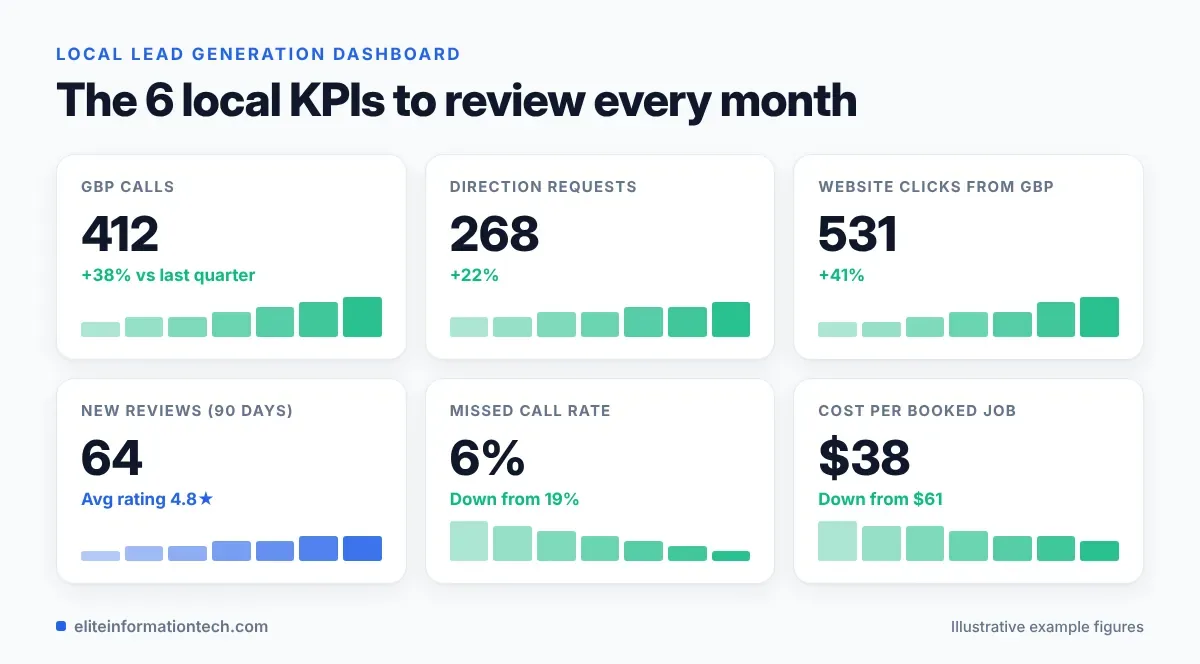
| Metric | Where to find it | Why it matters |
|---|---|---|
| GBP calls, messages and direction requests | Google Business Profile performance | Your highest-intent local leads |
| Map Pack visibility across your service area | Local rank grid tracking tools | Shows where you rank street by street |
| Review count, rating and velocity | GBP and review tools | Drives both rankings and conversion |
| Website calls and form fills by page | GA4 plus call tracking | Shows which service and location pages work |
| Missed call rate | Call tracking | Lost leads you already paid for |
| Cost per booked job | CRM | The number that decides profitability |
Local Lead Generation by Industry: Quick Wins
- Home services and contractors: emergency service pages, Local Services Ads, before-and-after photos, missed-call text-back.
- Healthcare and dental: treatment-specific pages, doctor profiles with credentials, online booking, reviews on healthcare platforms. See our healthcare marketing page.
- Legal: practice-area pages, attorney bios, case results where permitted, fast intake response. See legal marketing.
- Real estate: neighbourhood guides, property-type pages, WhatsApp-first contact. See real estate marketing.
- Education and training: course pages by location, open-day bookings, Meta lead ads with WhatsApp follow-up. See education marketing.
Citations: Where Your Business Should Be Listed
Citations are mentions of your business name, address and phone number on other websites. They help Google and AI assistants confirm that your business is real and where it operates. Prioritise quality and accuracy over volume:
- Core platforms: Google Business Profile, Apple Business Connect, Bing Places, Facebook, LinkedIn and Instagram.
- Major directories: Yelp, Foursquare, Yellow Pages and, in India, Justdial, Sulekha and IndiaMART where relevant.
- Industry directories: Practo or Healthgrades for healthcare, Avvo or Justia for legal, Houzz or Angi for home improvement, 99acres or Zillow for real estate.
- Local sources: chambers of commerce, business associations, local news sites and community directories.
Audit your existing listings first. Old addresses, outdated phone numbers and duplicate listings confuse search engines and customers alike. Fix inconsistencies before building new citations.
Lead Generation for Multi-Location Businesses
Franchises, clinic chains, retail brands and service companies with several branches face extra challenges. Each location needs its own visibility, but the brand needs consistency.
- One Google Business Profile per genuine location, each managed centrally with local photos and posts.
- A dedicated landing page per location with local team members, reviews, directions and a local phone number.
- Location-level reporting on calls, direction requests, reviews and leads so you can spot underperforming branches.
- Centralised review management that alerts the right branch manager to new reviews and tracks response times.
- Local paid campaigns with budgets adjusted by location performance and capacity.
Our franchise marketing work focuses on building systems that scale across dozens or hundreds of locations without losing the local touch.
Common Local Lead Generation Mistakes
- Using a virtual office or PO box as your address. This can lead to profile suspension and lost leads overnight.
- Keyword-stuffing the business name. It may help briefly, but it risks suspension and competitor reports.
- Ignoring the phone. Missed calls are the most expensive leak in local lead generation.
- Asking for reviews once, then stopping. Review recency matters; a burst followed by silence looks unnatural and goes stale.
- Thin location pages created only for rankings, with nothing useful for the reader.
- Not tracking GBP leads. Without UTM tags on your GBP website link and call tracking, you cannot see how much business the profile drives.
- Forgetting Apple Maps and Bing. BrightLocal's 2026 data shows Apple Maps usage for local discovery rising sharply. iPhone users matter.
A 60-Day Local Lead Generation Action Plan
Weeks 1–2: Audit and complete your Google Business Profile. Fix NAP consistency on the top 20 directories. Set up call tracking and missed-call text-back.
Weeks 3–4: Launch an automated review request flow. Respond to every existing review. Publish or improve your top three service pages.
Weeks 5–6: Create genuine location pages for your main service areas. Add LocalBusiness structured data. Start weekly GBP posts and photo uploads.
Weeks 7–8: Launch Local Services Ads or tightly targeted Search Ads. Pursue five local links or mentions. Review metrics and double down on what is working.
If you would rather hand this over, our Local SEO services and affordable local SEO packages are designed for service businesses of every size.