
Key takeaways
- Experienced SEO consultants most often charge $75–$150 per hour; monthly SEO retainers commonly run $500–$5,000+, depending on competition and scope.
- A freelance SEO expert suits small, well-defined jobs. An SEO agency suits businesses that want organic search to become a revenue channel, because it covers technical SEO, content, links, local and AI search under one roof.
- Anyone who guarantees #1 rankings or refuses to explain how they build backlinks is a red flag, every time.
- In 2027, your SEO hire must understand Generative Engine Optimization (GEO): getting cited inside AI answers, not just ranked in blue links.
- Start with a 90-day sprint tied to leads and revenue, then scale what works.
You are about to hand someone the keys to your most valuable marketing channel. Organic search still drives the cheapest, most compounding traffic a business can get, and in 2027 it also decides whether your brand gets mentioned when buyers ask ChatGPT, Gemini or Google's AI Overviews for a recommendation. So when you decide to hire an SEO expert, the stakes are higher than they have ever been. Pick the right person or team and every month builds on the last. Pick the wrong one and you can lose a year, a chunk of budget and, in the worst cases, your rankings.
This guide is the one we wish every business owner read before signing an SEO contract. We break down what a modern SEO specialist actually does, how a freelance SEO consultant compares to an SEO agency and an in-house hire, what SEO really costs in 2027, the questions that expose a weak candidate in minutes, and a 10-step checklist you can follow this week.
What does an SEO expert actually do in 2027?
The job title "SEO expert" covers a huge range of skills, and that is exactly why so many hires go wrong. A business owner thinks they are hiring a growth partner; they end up with someone who only edits meta titles. Before you compare candidates, it helps to know what a complete SEO program includes today.
1. Technical SEO
This is the foundation. A technical SEO specialist makes sure search engines can crawl, render and index your site. That covers site architecture, internal linking, XML sitemaps, canonical tags, structured data (schema markup), JavaScript rendering, redirect chains and page speed. Google's Core Web Vitals thresholds are clear: a Largest Contentful Paint under 2.5 seconds, Interaction to Next Paint under 200 milliseconds and Cumulative Layout Shift under 0.1. If your site misses these on mobile, great content still struggles.
2. Keyword research and search intent mapping
A good SEO consultant does not chase the biggest keywords. They map the searches your buyers actually make at each stage, from "what is" questions to "best", "cost" and "near me" queries, and match every important query to a page built to satisfy it. Getting intent wrong is one of the most common reasons pages rank and still fail to convert.
3. On-page SEO and content strategy
This includes title tags, headings, copy, FAQs, images and internal links, plus a content plan that builds topical authority over time. In 2027, content must show real experience: original data, examples, screenshots and clear authorship. Thin, mass-produced AI pages are a liability, not an asset.
4. Link building and digital PR
Backlinks remain one of the strongest ranking signals and a major input for which brands AI tools trust and cite. A professional builds links through outreach, guest posting on real sites, digital PR and partnerships. Our guide on why backlinks stop working explains what happens when this is done badly.
5. Local SEO
For service businesses, the Google Business Profile, reviews, citations and the Map Pack often drive more calls than the website itself. A local SEO specialist manages all of it. See our local SEO services for what that looks like in practice.
6. AI search optimization (GEO)
This is the newest and fastest-growing skill. AI Overviews, ChatGPT search, Perplexity, Gemini and Copilot now answer many questions without a click. Ahrefs' updated study found that when an AI Overview appears, the click-through rate for the top-ranking page is about 58% lower on average. The brands that win are the ones the AI cites. A modern SEO expert structures content so it can be quoted, builds brand mentions across trusted sites and tracks AI visibility. Learn more on our GEO and AI search optimization page.
7. Measurement and reporting
Finally, an SEO professional connects work to outcomes using Google Search Console, GA4, call tracking and CRM data. Rankings are a leading indicator. Leads, sales and revenue are the point.
The takeaway: very few individuals are excellent at all seven areas. That single fact shapes the freelancer-versus-agency decision more than price does.
Freelance SEO consultant vs SEO agency vs in-house: which should you hire?
Hiring a freelance SEO expert
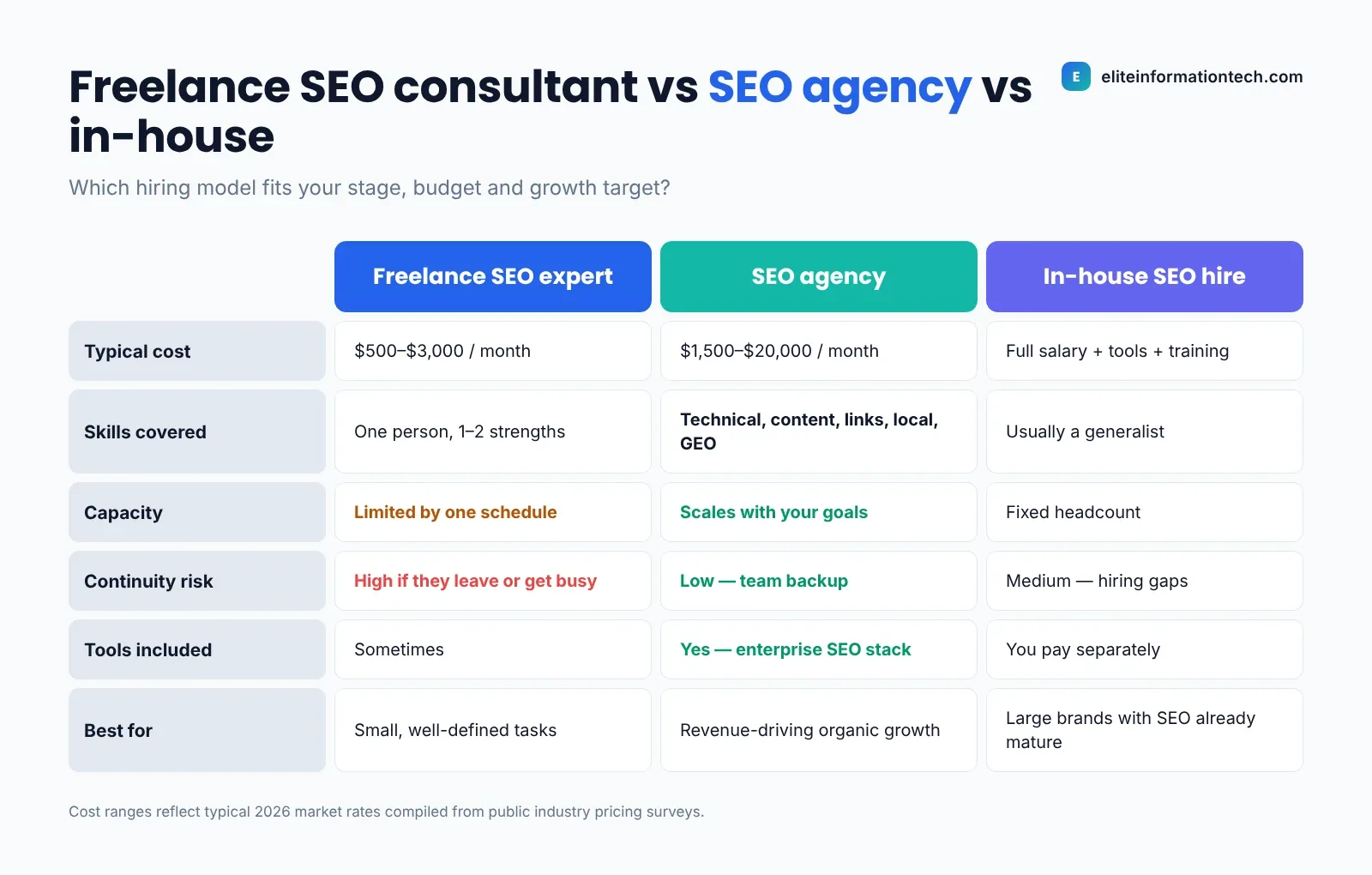
A freelance SEO specialist is an independent professional who works with a handful of clients. The best ones are sharp, responsive and cost-effective for focused jobs: a one-time technical audit, fixing indexing problems, optimizing a set of product pages or writing a content brief library.
Where freelancers shine: lower monthly cost, direct contact with the person doing the work, flexibility and speed on small tasks.
Where it gets risky: one person rarely covers technical, content, links, local and AI search at a high level. Capacity is limited by one calendar, so when they get busy, take a holiday or land a bigger client, your project slows or stops. Tools are often limited, and quality varies widely. Many low-priced SEO freelancers on gig platforms rely on cheap link packages that can do lasting damage.
Hiring an SEO agency
An SEO agency gives you a team: a strategist, technical specialists, writers, link builders and analysts, plus an enterprise tool stack. You pay more per month than for a single freelancer, but you get coverage of every discipline, built-in quality control and continuity if someone leaves.
Where agencies shine: complete strategy and execution, faster scaling, accountability through processes and reporting, and experience across many industries and markets.
Where it gets risky: some agencies sell a senior pitch and deliver junior work, or lock clients into long contracts with generic monthly reports. The fix is to vet the agency the same way you would vet an individual, using the questions later in this guide.
Hiring in-house
A full-time SEO manager makes sense when organic search is already a major channel and you have the budget for salary, benefits, tools and training. Even then, most in-house SEO leads work with an agency or specialist for link building, technical projects or content scale.
The hybrid model
Many growing businesses land here: a small internal marketing team owns strategy and brand, and an agency handles execution. Agencies that need extra capacity use the same approach through white-label SEO services.
A quick decision rule
- Budget under ~$500/month and one clear task? A vetted freelance SEO consultant or a fixed-price project.
- You want SEO to produce leads and revenue every month? An SEO agency or a senior consultant backed by a team.
- SEO already drives a big share of revenue? In-house lead plus an agency partner.
How much does it cost to hire an SEO expert in 2027?
SEO pricing confuses buyers because three different pricing models are in use and quotes vary by 10x for work that sounds similar. Here is what the market looks like.
Hourly SEO rates
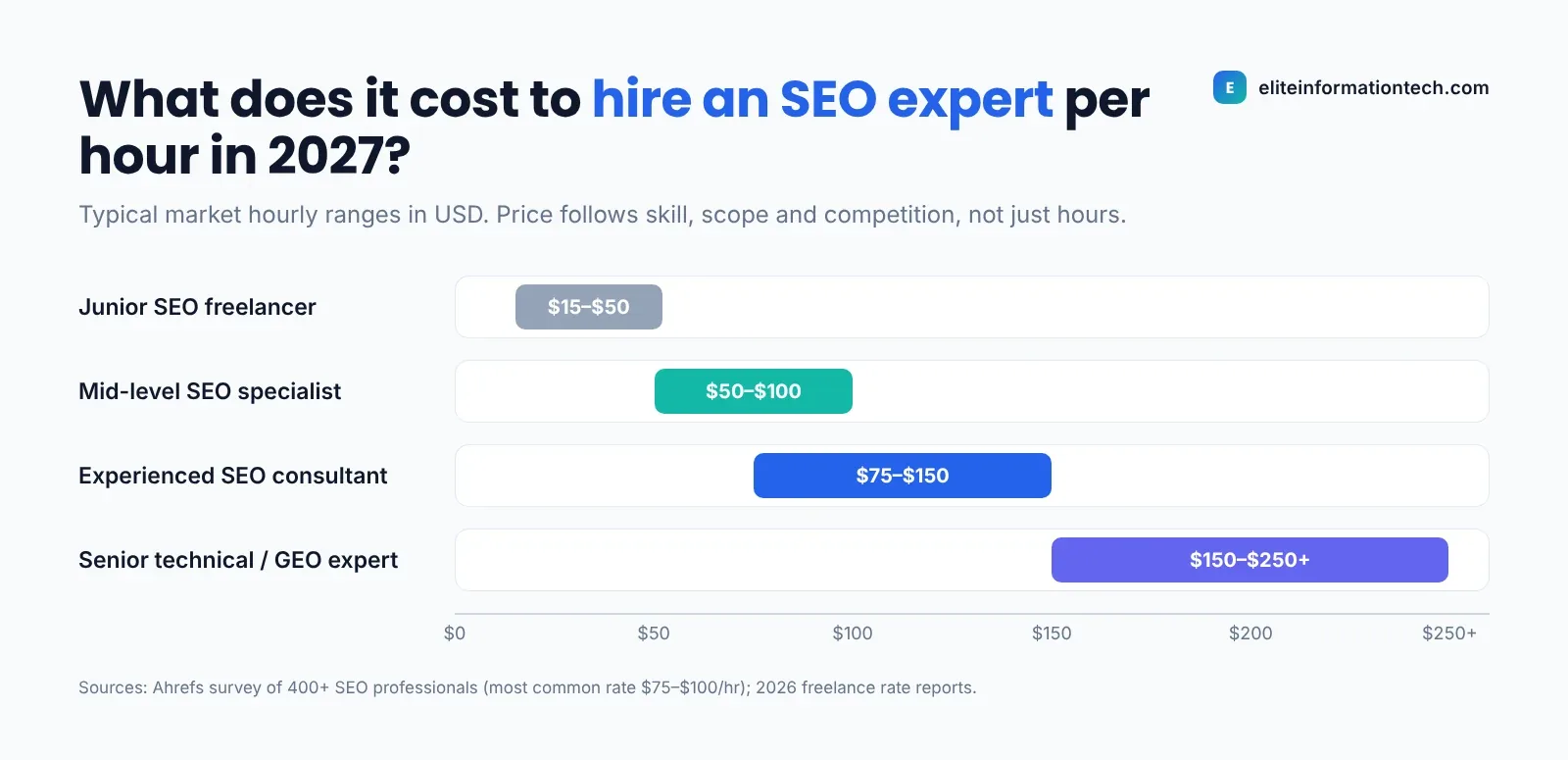
In Ahrefs' survey of more than 400 SEO professionals, $75–$100 per hour was the most common rate, and 90% charged $150 per hour or less. The same survey found agencies and consultants were more likely than individual freelancers to charge $75+ per hour, and experience pushed rates up. In practice:
- Junior SEO freelancer: roughly $15–$50 per hour. Fine for simple tasks under supervision.
- Mid-level SEO specialist: around $50–$100 per hour.
- Experienced SEO consultant: around $75–$150 per hour.
- Senior technical SEO or GEO specialist: $150–$250+ per hour for complex migrations, enterprise sites or competitive niches.
Monthly SEO retainers
Most ongoing SEO is sold as a monthly retainer. Typical ranges look like this:
| Business type | Typical monthly SEO budget | What it usually covers |
|---|---|---|
| Local service business (one location) | $500–$1,500 | Google Business Profile, local pages, citations, reviews, a few links |
| Small business / multi-location | $1,500–$3,500 | Technical fixes, content, local SEO, link building, reporting |
| E-commerce store | $2,000–$6,000 | Category and product SEO, schema, technical, content, links |
| B2B / SaaS | $3,000–$10,000 | Content strategy, thought leadership, digital PR, GEO |
| Enterprise / international | $10,000–$20,000+ | Full program across markets, languages and teams |
Project-based SEO pricing
One-time projects usually fall between $500 and $10,000+. An SEO audit for a small site may cost $500–$1,500; a full audit with an implementation roadmap for a large e-commerce site can run $5,000 or more. Site migrations, which carry real risk, sit at the higher end.
What makes SEO cost more (or less)
- Competition: ranking a law firm in a major city costs more than ranking a niche B2B supplier.
- Site size and condition: a 5,000-page store with technical debt needs more work than a 20-page site.
- Content and link volume: these are the biggest cost drivers in most retainers.
- Markets and languages: each new country or language adds research, content and links.
- Speed: faster timelines mean more resources each month.
One warning: the cheapest SEO is often the most expensive. A $150-a-month package that buys spammy links can trigger a ranking drop that takes a year and thousands of dollars to repair. If you need a lower entry point, look for transparent small business SEO packages with clear deliverables instead.
When does hiring a freelance SEO consultant make sense?
Freelancers are a great fit in specific situations. Hire a freelance SEO expert when:
- You need a one-off technical audit or a second opinion on your current provider.
- You have a small, clearly scoped task, like fixing schema or optimizing 20 product pages.
- You already have an in-house marketer who can manage the work and implement recommendations.
- Your budget is limited and you would rather do a little SEO well than a lot badly.
Choose an SEO agency or a consultant backed by a team when:
- You want SEO to become a predictable lead or sales channel.
- Your site needs technical work, content and links at the same time.
- You operate in a competitive market or across several locations or countries.
- You need reliability: no stalled months when one person is unavailable.
- You want to show up in AI answers, which takes coordinated content, PR and technical work.
10 questions to ask before you hire an SEO specialist
These questions work for any candidate, whether a remote SEO expert, a local consultant or a large agency. Listen for specifics. Vague answers are an answer.
- "What would you focus on first for my site, and why?" A real expert will have looked at your site and will mention specific issues and opportunities, not a generic package.
- "Can you show me results for a business like mine?" Ask for case studies with Google Search Console or analytics screenshots, ideally in your industry or a similar market.
- "How do you build backlinks?" You want to hear about outreach, real publications, digital PR and relevance. If they will not explain, walk away.
- "How will you measure success?" The right answer links to leads, sales or revenue, with rankings and traffic as supporting metrics.
- "What do you need from me?" Good SEO needs access, approvals and input. A candidate who needs nothing from you is not planning to do much.
- "How do you approach AI Overviews and ChatGPT visibility?" In 2027, an SEO consultant without a GEO answer is behind.
- "Who will actually do the work?" With agencies, meet the account lead. With freelancers, ask if anything is subcontracted.
- "What happens if we stop working together?" You should keep all content, accounts, data and links. No exceptions.
- "What does a typical monthly report include?" Ask to see a sample. Look for insight and next actions, not just charts.
- "What results can I realistically expect in 3, 6 and 12 months?" Honest experts give ranges and explain the assumptions. Nobody can promise exact rankings.
Red flags and green flags when you hire an SEO expert
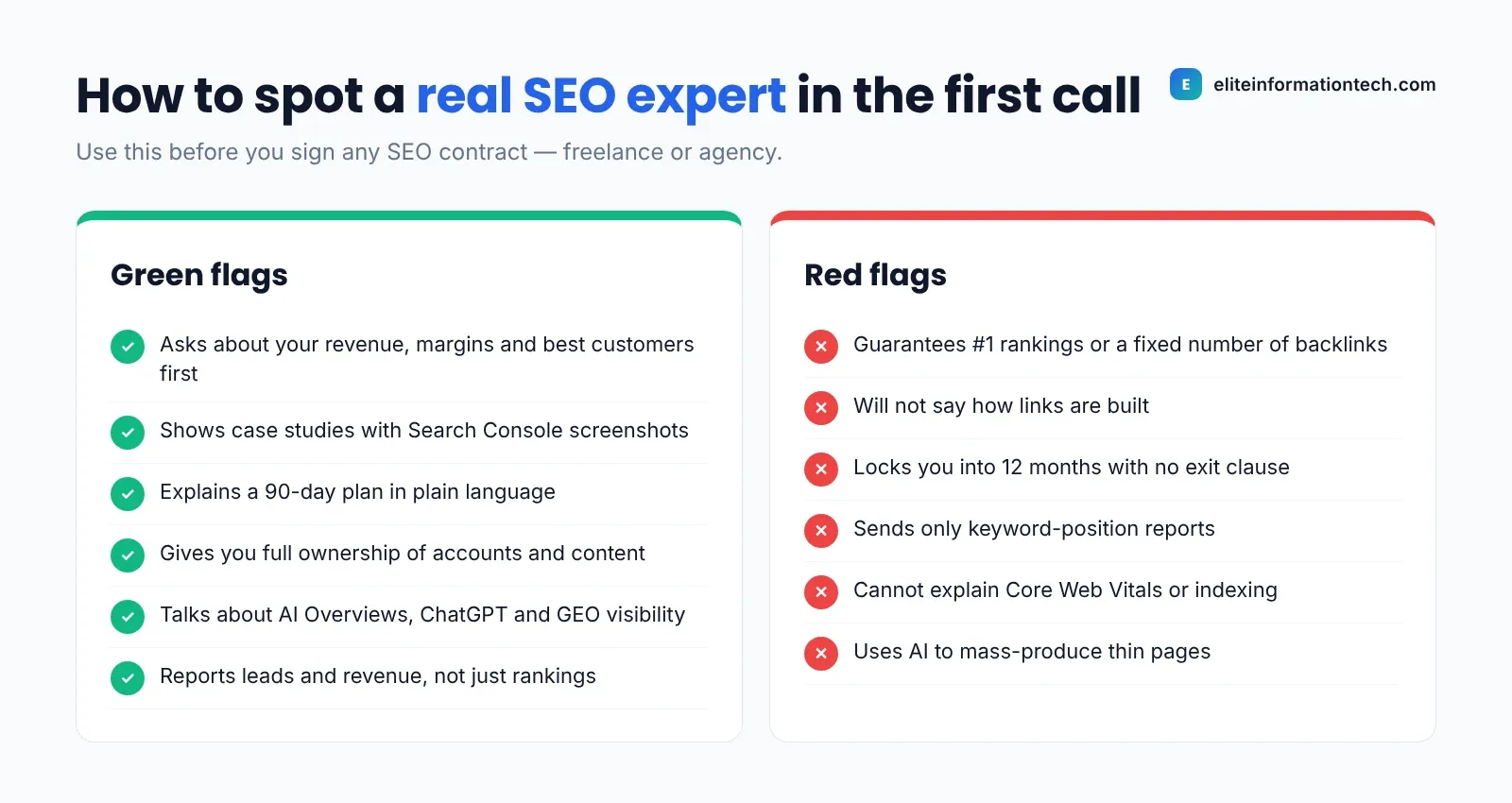
Most bad SEO relationships could have been avoided in the first conversation. Watch for these warning signs:
- Ranking guarantees. Google's own guidance on hiring an SEO warns that no one can guarantee a #1 ranking.
- "500 backlinks for $99." Volume-based link packages almost always mean private blog networks or spam.
- Secret methods. Real SEO is not a secret. A professional explains the work clearly.
- Long lock-in contracts with no exit clause or performance review.
- Reports that only show rankings for keywords nobody searches.
- Mass AI content published without editing, expertise or fact-checking.
And the signs you have found a keeper:
- They ask about your business model, margins and best customers before talking tactics.
- They give you a clear 90-day plan with priorities and expected impact.
- They put accounts and assets in your name.
- They speak plainly about risks and timelines.
- They report on qualified leads and revenue, and they explain what they will do next.
The 10-step checklist to hire the right SEO expert
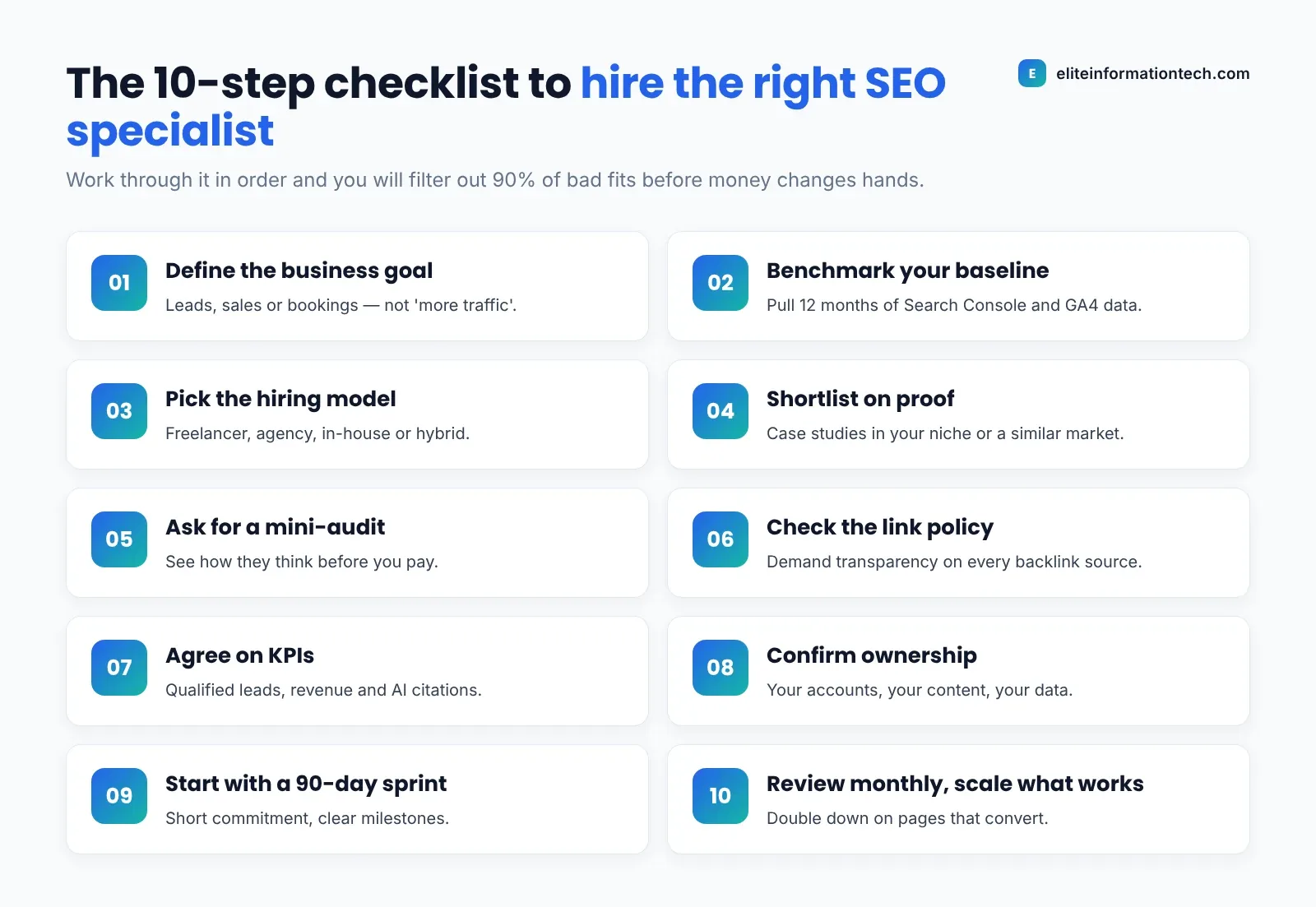
- Define the business goal. Write down the outcome you want: 40 more qualified leads a month, 25% more online revenue, or more bookings in two new cities.
- Benchmark your baseline. Export 12 months of Search Console and GA4 data so you can measure progress fairly.
- Choose the hiring model. Freelancer, agency, in-house or hybrid, based on budget and goals.
- Shortlist on proof, not promises. Prioritize case studies in your niche or a comparable market.
- Request a mini-audit or strategy call. How they diagnose your site tells you more than any sales deck. Elite offers a free growth audit with the three highest-impact fixes.
- Interrogate the link policy. Ask for example placements and how sites are vetted.
- Agree on KPIs. Qualified leads, revenue, conversion rate, priority rankings and AI citations.
- Confirm ownership in writing. Your domain, analytics, Search Console, content and backlinks stay yours.
- Start with a 90-day sprint. A short commitment with clear milestones lowers your risk.
- Review monthly and scale what works. Put more budget behind the pages and topics that convert.
How long does SEO take to work? A realistic timeline
Expect SEO to build momentum over months, not days. A typical timeline for a business starting with a reasonably healthy site:
- Month 1: audit, keyword and competitor research, tracking setup, quick technical wins. Small ranking movement on existing pages is common.
- Months 2–3: new and improved pages go live, internal linking improves, link building starts. Impressions in Search Console usually rise first.
- Months 4–6: rankings for mid-competition keywords move onto page one, and leads begin to climb.
- Months 6–12: compounding growth. Authority builds, competitive keywords move, and AI tools begin to cite your content more often.
Speed depends on competition, budget and site condition. Our own work shows the range: a 28-day technical sprint for an open-access journal lifted organic clicks by 72% and moved its average position from 16.6 to 9.2, while longer programs, like the one for electrical contractor Vuta Electrical, delivered an 860% year-over-year increase in organic sessions. You can read the details in our SEO case studies.
Hiring an SEO expert for AI search: what changes in 2027
Search behaviour has split. Buyers still use Google, but they also ask AI assistants to compare options and recommend providers. A randomized field study reported by Search Engine Journal found AI Overviews cut organic clicks by 38% on queries where they appeared. Traffic is not disappearing; it is concentrating on the brands AI systems trust.
When you hire an SEO specialist today, make sure they can:
- Write answer-first content with clear definitions, numbers and short summaries that AI tools can quote.
- Use structured data (FAQ, Article, Product, Organization, LocalBusiness) so machines understand your content.
- Build brand mentions on trusted publications, industry directories and review sites. AI models learn which brands are credible from the wider web.
- Strengthen E-E-A-T with real authors, credentials, original research and case studies.
- Track AI visibility, such as how often your brand is cited for priority prompts, alongside rankings.
Our guide to link building for the AI search era goes deeper into how links and mentions influence AI citations.
Why businesses hire Elite Information Tech as their SEO partner
Since 2008, Elite Information Tech has helped businesses across 98+ industries grow through search. Instead of a single freelancer juggling everything, you get a dedicated team of specialists from our 249+ strong bench, with senior strategists, technical SEOs, writers, link builders and analysts working on one plan.
- Full-funnel SEO: technical, on-page, content, link building, local and e-commerce SEO.
- AI search built in: GEO for Google AI Overviews, ChatGPT, Gemini, Perplexity and Copilot.
- Proven results: 90% of tracked keywords on page one of Google.ie for Vanparts.ie, an average position jump from 31 to 3.5 for MaxCarTravel, and 115+ ranking keywords for Quality Marine Clothing.
- Transparent reporting: leads and revenue you can trace, with full ownership of every asset.
- Flexible engagement: small packages for growing businesses, full programs for scaling brands, and white-label delivery for agencies.
Explore our SEO services or see what clients say on our testimonials page.